






Too sour
The short answer It's normal
It's normal: the longer it ferments, the more sour it gets, in the fridge too. Next time, taste it sooner and move it to the fridge when you like it. Kombucha has a limit: below pH 2.5, don't drink it.
Reviewed October 26, 2026 · 15 facts, each with its source
 AI
When in doubt, throw it out. Fervida can’t see your jar. No page can tell you something is safe: it can show you how to look.
What you see
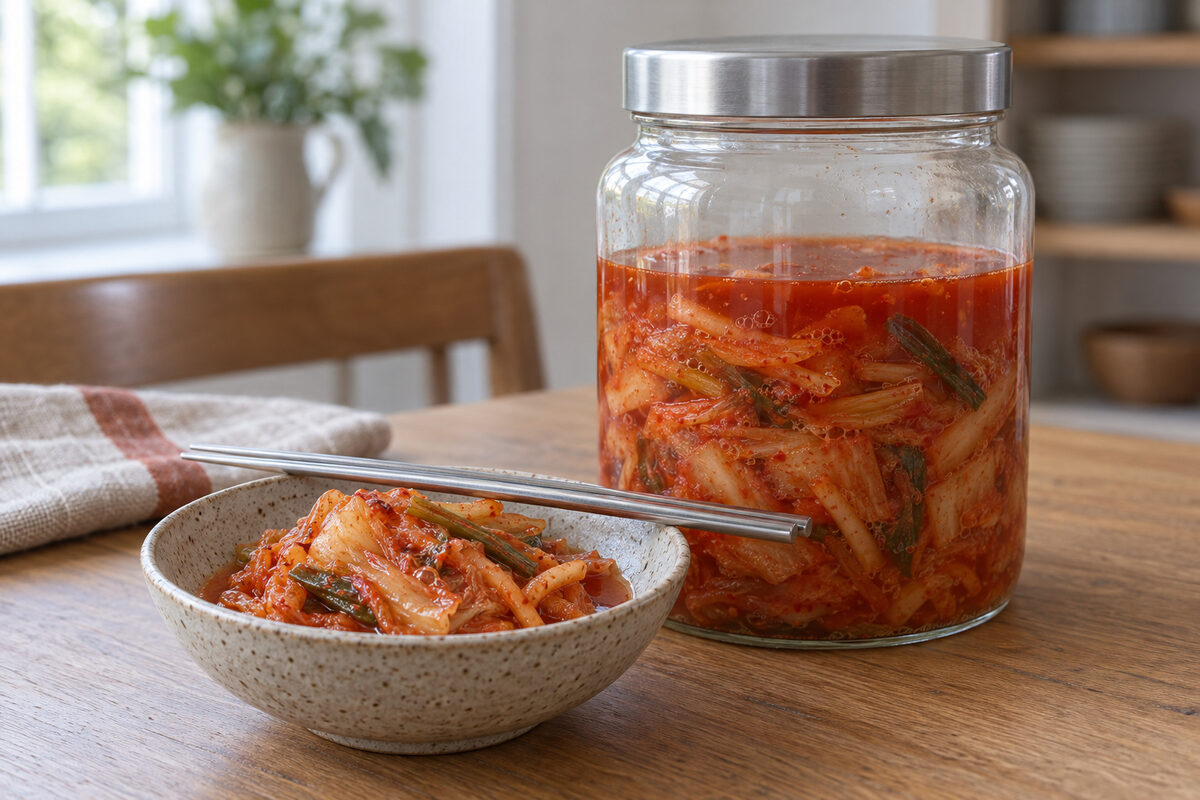
More sour than you like: it stings your tongue and you can barely taste the vegetables. It usually happens with a ferment left out of the fridge for many weeks, in summer, or with a jar that has been in the fridge for a long time.
Why it happens
Sourness is what fermentation makes: bacteria turn the sugar in the vegetables into lactic acid, and that acid builds up. The longer it ferments, the more sour it gets.
- When it's warm, everything goes faster.
- In the fridge, fermentation doesn't stop: it carries on slowly, and the flavor keeps changing. Kimchi, for example, gets more sour over time.
What to do
It's normal: it's a matter of time
In vegetables, very sour is a matter of taste. The limit the guides set runs the other way: the pH must not rise above 4.6. What does mean throwing it out is something else: a rotten smell, sliminess or mold.
If you don't like it this way, stop sooner next time: taste it while it ferments and move it to the fridge when it's how you like it.
Kombucha is the exception. It has a lower limit: so it doesn't become dangerously acidic, its pH should not drop below 2.5. If you measure it below that, don't drink it. See "Kombucha tastes like vinegar". For kefir, "Kefir is too sour".
How to stop it where you like it
- Taste it often once it starts to sour.
- When you like it, into the fridge. It will keep changing there, but much more slowly.
- The ideal temperature, 68–72 °F. When it's warmer, it gets there sooner.
- For kombucha, the full recipe, never a half batch with the same SCOBY, and into the fridge on time: the cold holds back excess acid.
Where every figure comes from
Every statement on this page comes from a food safety guide. We keep a copy of each source and quote its exact words, in its original language.
-
1
Bacteria turn sugar into lactic acid
“these bacteria convert sugars into lactic acid”
University of Illinois Extension · Fermentation handout (2020) · read on October 20, 2026
-
2
A shorter fermentation for less sourness; longer for more tang
“Generally, if you want a less sour product, use a shorter fermentation time; longer for more tang.”
University of Illinois Extension · Fermentation handout (2020) · read on October 20, 2026
-
3
The flavor keeps changing in the fridge, because the process slowly continues
“Expect subtle changes in flavor even during refrigeration (the process slowly continues).”
University of Illinois Extension · Fermentation handout (2020) · read on October 20, 2026
-
4
If it is slimy or smells rotten, throw it out
“If fermented product is slimy, smells spoiled/rotten, discard it.”
University of Illinois Extension · Fermentation handout (2020) · read on October 20, 2026
-
5
The ideal temperature, 68–72 °F
“Control room temperature– ideal=68-72°F”
University of Illinois Extension · Fermentation handout (2020) · read on October 20, 2026
-
6
Kimchi gets more sour over time
“Kimchi may become more sour over time.”
Colorado State University Extension · Understanding and Making Kimchi (2025) · read on October 20, 2026
-
7
In kombucha, cool temperatures slow fermentation and warm ones speed it up
“Cooler temperatures may slow fermentation, while warmer temperatures can accelerate it.”
University of Georgia Cooperative Extension (National Center for Home Food Preservation) · Crafting Kombucha at Home: Frequently Asked Questions (2026) · read on October 20, 2026
-
8
A half batch with the same SCOBY can turn out too acidic
“It's not recommended to make a half batch of kombucha. Doing so could lead to excessive acidity due to the same amount of SCOBY used”
University of Georgia Cooperative Extension (National Center for Home Food Preservation) · Crafting Kombucha at Home: Frequently Asked Questions (2026) · read on October 20, 2026
Show the remaining 7 claims
-
9
Fermentation takes less time when it's warm and goes more slowly when it's cool
“generally taking less time at higher temperatures and proceeding more slowly at lower temperatures.”
BC Centre for Disease Control, Environmental Health Services · Safety of Fermented Foods, Section 3.1: Fermented Vegetables (August 2024, updated December 2024) · read on October 25, 2026
-
10
The pH must not rise above 4.6
“The pH can be checked periodically to ensure it does not rise above 4.6.”
UC Davis, Department of Food Science and Technology · Common issues with fermented fruits and vegetables (v1.0, 15-mar-2022) · read on October 20, 2026
-
11
If there is mold anywhere, the whole batch goes
“If you confirm mold growth on any part of a ferment, it should be immediately discarded.”
UC Davis, Department of Food Science and Technology · Common issues with fermented fruits and vegetables (v1.0, 15-mar-2022) · read on October 20, 2026
-
12
So kombucha doesn't become dangerously acidic, its pH should not drop below 2.5
“To prevent the product from getting dangerously acidic, the pH should be no lower than 2.5.”
Virginia Cooperative Extension (Virginia Tech) · What do I need to know to sell KOMBUCHA at the farmers market? (FST-297, last reviewed November 2025) · read on October 20, 2026
-
13
The fridge holds back alcohol and excess acid
“Refrigeration limits alcohol and excessive acid production.”
Virginia Cooperative Extension (Virginia Tech) · What do I need to know to sell KOMBUCHA at the farmers market? (FST-297, last reviewed November 2025) · read on October 20, 2026
-
14
Taste sauerkraut to tell whether it has fermented enough for you
“Taste the kraut to determine if the kraut has fermented enough for your taste.”
Washington State University Extension, Lewis County · Sauerkraut Making · read on October 26, 2026
-
15
Then, into the fridge
“Transfer to the refrigerator.”
K-State Research and Extension (Kansas State University) · Taking a New Look at Fermented Foods (MF3491, June 2020) · read on October 20, 2026