






Grainy, split yogurt
The short answer It can be fixed
You can fix it if it smells like yogurt. It usually comes from too many hours, milk not heated enough or moving it while it sets. Stir it or strain it in the fridge. If it smells of anything else or there's mold, throw it out.
Reviewed October 26, 2026 · 18 facts, each with its source
 AI
When in doubt, throw it out. Fervida can’t see your jar. No page can tell you something is safe: it can show you how to look.
What you see
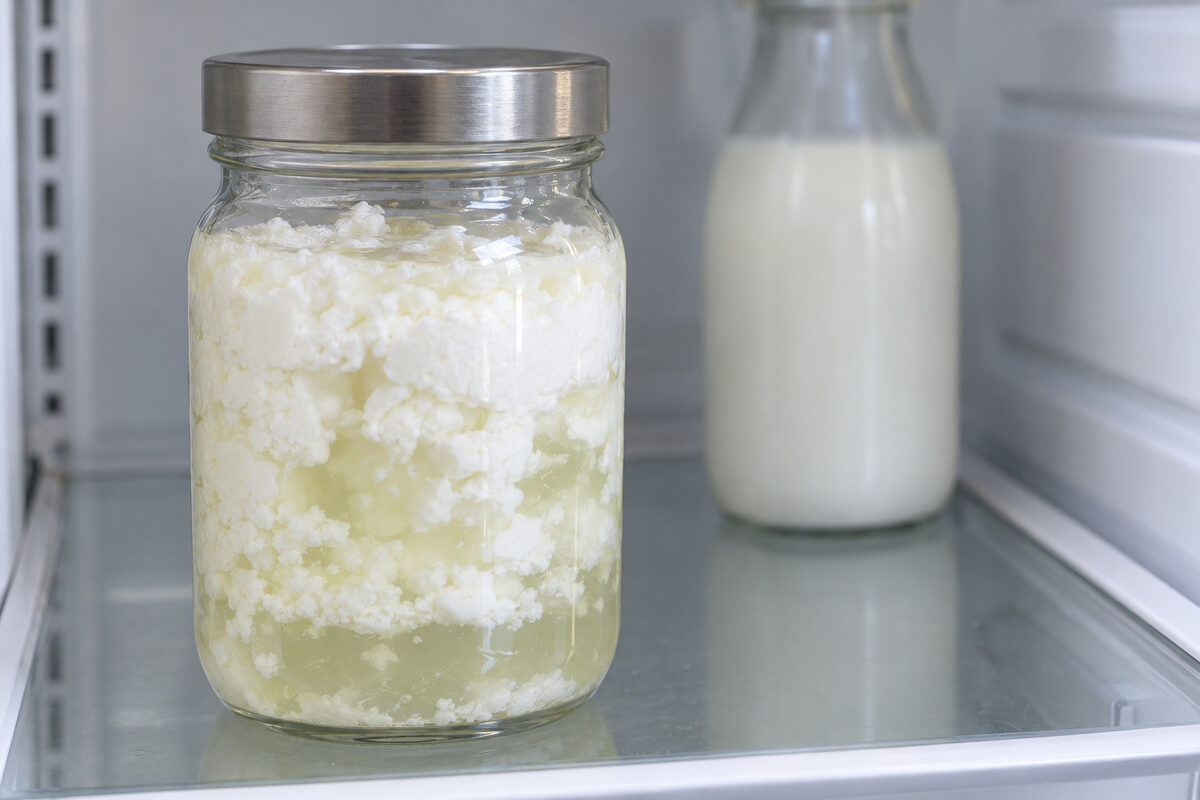
Curds and a yellowish or greenish liquid, the whey, apart from the rest. The yogurt is no longer smooth: it looks split, like cottage cheese in its whey. Sometimes it happens at the end of the incubation; other times, after a few days in the fridge. A little whey on top is normal; this is much more.
Why it happens
Yogurt splits when the milk proteins, instead of setting together into a smooth mass, separate into curds and whey. It's usually one of these:
- Too many hours. If it keeps incubating for hours after it has set, it gets more acidic and ends up releasing whey. The same if it's slow to go into the fridge: cold is what stops the acid.
- Milk not heated enough. Heating first, to 185–200 °F (85–93 °C), changes the proteins so they set together instead of splitting into curds and whey.
- Moving it while it sets. Stirring or moving the jars makes it release more whey.
- Clumps from milk powder. Added to milk that's already hot, some of the proteins form clumps or strings before the starter goes in.
What to do
You can fix it if it smells like yogurt
- Look at it first. If you see mold or it smells of anything but the sourness of fresh yogurt, throw it all out, without sniffing it up close.
- If it's only split and smells like yogurt, it's a texture issue. Stir it to bring the whey back in, or strain it: put it in a strainer lined with cloth, cover it and leave it in the fridge. After 2 to 4 hours it's Greek-style; after 8 to 24, a yogurt cheese like labneh. Without the whey it's thicker, and the curds show less.
- Always strain it in the fridge, never on the counter.
If it never set in the first place, that's a different case: see “Runny yogurt.”
How to prevent it
- Into the fridge as soon as it sets firm. Don't leave it in the yogurt maker for extra hours.
- Heat the milk to 185–200 °F (85–93 °C) and hold it 10 minutes, or 20 for a firmer yogurt. Don't let it boil.
- Don't move the jars while it sets.
- Milk powder goes into the cold milk, before heating. If clumps or strings form as it heats, take them out with a slotted spoon or strain the milk before adding the starter.
Where every figure comes from
Every statement on this page comes from a food safety guide. We keep a copy of each source and quote its exact words, in its original language.
-
1
Heat makes the proteins set together instead of splitting into curds and whey
“Heating the milk is a necessary step to change the milk proteins so that they set together rather than to form curds and whey.”
National Center for Home Food Preservation (Nummer, 2002); copy hosted by UC Davis Food Safety · Fermenting Yogurt at Home (October 2002) · read on October 25, 2026
-
2
Hours past setting: more acid and, in the end, the whey separates
“Incubating yogurt for several hours past the time after the yogurt has set will produce more acidity. This will result in a more tart or acidic flavor and eventually cause the whey to separate.”
National Center for Home Food Preservation (Nummer, 2002); copy hosted by UC Davis Food Safety · Fermenting Yogurt at Home (October 2002) · read on October 25, 2026
-
3
Cold stops the acid
“Rapid cooling stops the development of acid.”
National Center for Home Food Preservation (Nummer, 2002); copy hosted by UC Davis Food Safety · Fermenting Yogurt at Home (October 2002) · read on October 25, 2026
-
4
A little whey on top is normal
“This is called syneresis. Some syneresis is natural.”
National Center for Home Food Preservation (Nummer, 2002); copy hosted by UC Davis Food Safety · Fermenting Yogurt at Home (October 2002) · read on October 25, 2026
-
5
A lot of whey comes from incubating too long or moving it while it sets
“Excessive separation of whey, however, can be caused by incubating yogurt too long or by agitating the yogurt while it is setting.”
National Center for Home Food Preservation (Nummer, 2002); copy hosted by UC Davis Food Safety · Fermenting Yogurt at Home (October 2002) · read on October 25, 2026
-
6
Milk powder in hot milk forms clumps and strings
“Adding non-fat dry milk to heated milk will cause some milk proteins to coagulate and form strings.”
National Center for Home Food Preservation (Nummer, 2002); copy hosted by UC Davis Food Safety · Fermenting Yogurt at Home (October 2002) · read on October 25, 2026
-
7
Thrown out if there's mold or it smells of anything but yogurt
“Discard any yogurt samples with visible signs of microbial growth or any odors other than the acidity of fresh yogurt.”
National Center for Home Food Preservation (Nummer, 2002); copy hosted by UC Davis Food Safety · Fermenting Yogurt at Home (October 2002) · read on October 25, 2026
-
8
Into the fridge as soon as it sets firm
“Refrigerate yogurt immediately after a firm coagulum has formed.”
National Center for Home Food Preservation (Nummer, 2002); copy hosted by UC Davis Food Safety · Fermenting Yogurt at Home (October 2002) · read on October 25, 2026
Show the remaining 10 claims
-
9
It separates if the milk wasn't heated enough before adding the starter
“Milk was not heated enough before adding a yogurt starter.”
University of Illinois Extension · Making Yogurt at Home, Best Practice Guide (modified May 2024) · read on October 25, 2026
-
10
It separates if it doesn't go into the fridge soon
“Yogurt was not refrigerated soon after incubation.”
University of Illinois Extension · Making Yogurt at Home, Best Practice Guide (modified May 2024) · read on October 25, 2026
-
11
If it separates, stir to recombine
“Yogurt may start to separate; stir to recombine.”
University of Illinois Extension · Making Yogurt at Home, Best Practice Guide (modified May 2024) · read on October 25, 2026
-
12
Covered, in the fridge: 2 to 4 hours for Greek-style, 8 to 24 for yogurt cheese
“Cover the container and refrigerate. For yogurt cheese, drain for 8 to 24 hours. For Greek-style yogurt, drain for 2 to 4 hours.”
University of Illinois Extension · Making Yogurt at Home, Best Practice Guide (modified May 2024) · read on October 25, 2026
-
13
Clumps from heating come out with a slotted spoon or by straining before adding the starter
“Take the solids out with a slotted spoon or, in difficult cases, after cooking pour the milk mixture through a clean colander or cheesecloth before adding the starter.”
University of Alaska Fairbanks Cooperative Extension Service · Making Yogurt at Home (FNH-00062, reviewed October 2024) · read on October 25, 2026
-
14
185–200 °F for 10 or 20 minutes, without boiling
“Hold temperature at 185° to 200°F for 10 minutes for thinner yogurt or up to 20 minutes for thicker yogurt. Do not boil.”
University of Alaska Fairbanks Cooperative Extension Service · Making Yogurt at Home (FNH-00062, reviewed October 2024) · read on October 25, 2026
-
15
Moldy yogurt goes, all of it
“Yogurt and sour cream Discard Foods with high moisture content can be contaminated below the surface.”
USDA Food Safety and Inspection Service · Molds on Food: Are They Dangerous? · read on October 20, 2026
-
16
Don't sniff mold
“Don't sniff the moldy item. This can cause respiratory trouble.”
USDA Food Safety and Inspection Service · Molds on Food: Are They Dangerous? · read on October 20, 2026
-
17
Removing whey makes it thicker
“Removing whey will yield a thicker, more viscous product (Greek style).”
Province of British Columbia (Ministry of Health, BCCDC Environmental Health Services, Fraser Health), Guidelines for the Production of Dairy Products in Food Establishments · Sample documentation: Yogurt, production of dairy products in food service establishments · read on October 25, 2026
-
18
Always strained in the fridge
“Straining step must be performed under refrigeration.”
Province of British Columbia (Ministry of Health, BCCDC Environmental Health Services, Fraser Health), Guidelines for the Production of Dairy Products in Food Establishments · Sample documentation: Yogurt, production of dairy products in food service establishments · read on October 25, 2026