






Too salty
The short answer It can be fixed
It can be fixed. If it has already soured, rinse only the portion you're about to eat, right before serving, and leave the rest in its brine. Next time, weigh the salt.
Reviewed October 26, 2026 · 13 facts, each with its source
 AI
When in doubt, throw it out. Fervida can’t see your jar. No page can tell you something is safe: it can show you how to look.
What you see
When you taste it, the salt drowns out the sourness and one bite is enough. Pickles may come out shriveled. Sometimes it also ferments slowly: few bubbles, and it takes a long time to sour.
Why it happens
It's almost always more salt than the recipe calls for. The most common reason is measuring it by the spoonful instead of weighing it: a spoonful of flake salt, for example, doesn't weigh the same as a spoonful of fine salt.
Extra salt doesn't only show in the flavor:
- A brine that is too strong shrivels pickles.
- It slows down the lactic acid bacteria: fermentation takes longer and more yeast grows.
- With too much salt, it doesn't ferment at all and the pH doesn't drop.
What to do
It can be fixed, at serving time
- First, check that it has soured. If you have strips or a pH meter, the pH has to be 4.6 or lower. If it hasn't soured, it's no longer a matter of taste: see "It isn’t souring".
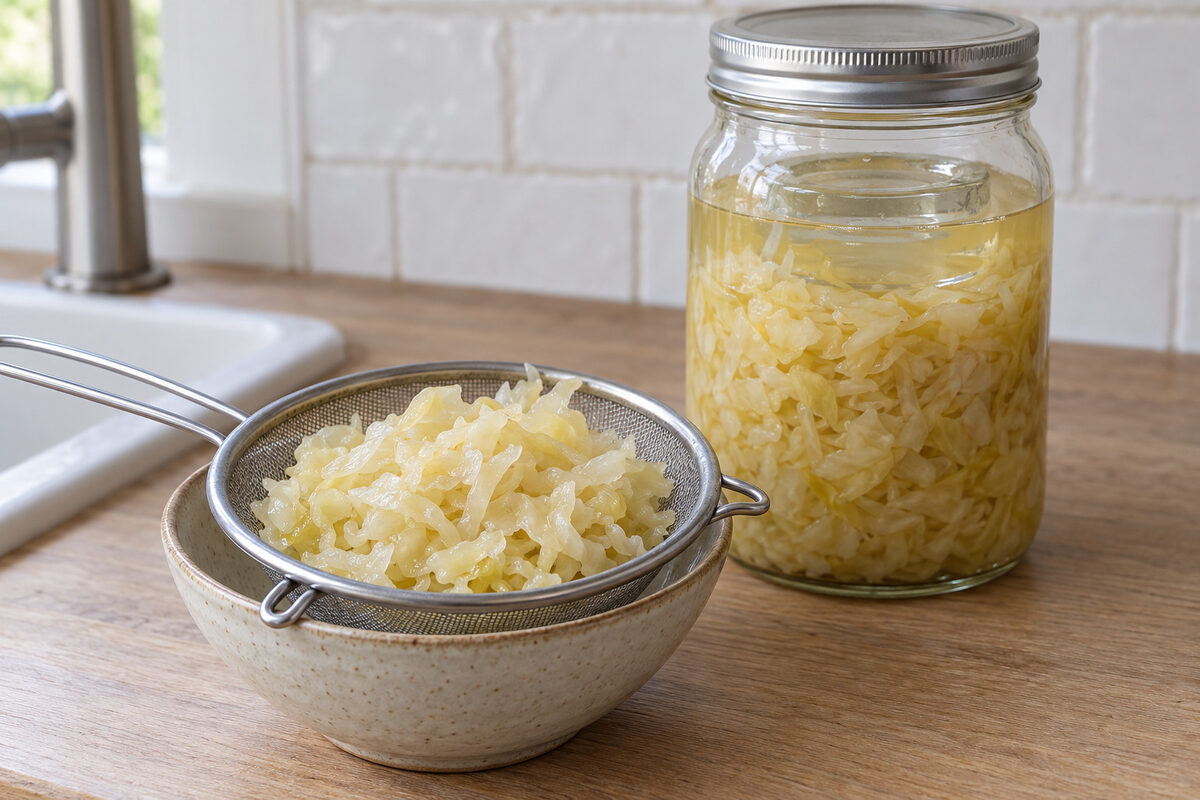
- If it is sour, rinse only the portion you're about to eat under the tap, right before serving. The water takes away some of the salt, as is done with preserved lemons.
- Leave the rest in its brine, with every vegetable below it, and don't water it down. In a vegetable ferment, salt is part of what protects it.
How to prevent it
- Weigh the salt. A spoonful of one salt doesn't weigh the same as a spoonful of another.
- Use what the recipe calls for. Generally, 3% for shredded vegetables like cabbage, and a 5% brine for large vegetables like cucumbers and carrots.
- Don't swing the other way: cutting the salt below what the recipe calls for is unsafe.
- Canning or pickling salt.
Where every figure comes from
Every statement on this page comes from a food safety guide. We keep a copy of each source and quote its exact words, in its original language.
-
1
A brine that is too strong shrivels pickles
“Placing cucumbers in too strong brine, too heavy syrup, or too strong vinegar.”
National Center for Home Food Preservation (USDA, University of Georgia) · Causes and Possible Solutions for Problems with Fermented Pickles · read on October 26, 2026
-
2
The salt the recipe calls for
“Use amounts of salt and sugar called for in a recipe”
National Center for Home Food Preservation (USDA, University of Georgia) · Causes and Possible Solutions for Problems with Fermented Pickles · read on October 26, 2026
-
3
Use canning or pickling salt
“Use canning or pickling salt.”
National Center for Home Food Preservation (USDA, University of Georgia) · Causes and Possible Solutions for Problems with Fermented Pickles · read on October 26, 2026
-
4
With too much salt, lactic acid bacteria slow down, yeasts grow and fermentation takes longer
“High salt can slow the growth of LAB allowing yeast growth and may result in longer fermentation times.”
BC Centre for Disease Control, Environmental Health Services · Safety of Fermented Foods, Section 3.1: Fermented Vegetables (August 2024, updated December 2024) · read on October 25, 2026
-
5
With too much salt it won't ferment and the pH won't drop
“If there is too much salt in the brine, fermentation will not occur and the pH will not drop to become more acidic.”
University of Minnesota Extension · Preserving food at home: Fermentation (reviewed 2026) · read on October 25, 2026
-
6
The ferment is ready when the pH reaches 4.6 or lower
“When a pH of 4.60 or lower is reached and bubbling has stopped, the ferment is ready.”
University of Minnesota Extension · Preserving food at home: Fermentation (reviewed 2026) · read on October 25, 2026
-
7
Salt is best weighed
“It is best to weigh salt for accuracy.”
University of Illinois Extension · Fermentation handout (2020) · read on October 20, 2026
-
8
Generally, 5% salt for large vegetables and 3% for shredded ones
“Generally 5% salt concentrations are used for large vegetables (cucumbers and carrots) and a 3% concentration is used for shredded vegetables (cabbage).”
University of Illinois Extension · Fermentation handout (2020) · read on October 20, 2026
Show the remaining 5 claims
-
9
Flake salt doesn't weigh the same from one spoonful to the next
“Since flake salt varies in density, it is not recommended for making pickled and fermented foods.”
National Center for Home Food Preservation (USDA, University of Georgia) · General Information on Fermenting · read on October 26, 2026
-
10
In sauerkraut and fermented pickles, salt is vital to safety and texture
“the salt used in making fermented sauerkraut and brined pickles not only provides characteristic flavor but also is vital to safety and texture.”
National Center for Home Food Preservation (USDA, University of Georgia) · General Information on Fermenting · read on October 26, 2026
-
11
Rinsing under the tap removes excess salt
“Rinse under water to remove excess salt.”
Clemson Cooperative Extension, Home & Garden Information Center (Jessica Hardiman) · Traditional Preserved Lemons: How to Make and Use Preserved Lemons at Home (January 2026) · read on October 25, 2026
-
12
Everything below the brine
“All produce should be submerged in the brine liquid.”
UC Davis, Department of Food Science and Technology · Common issues with fermented fruits and vegetables (v1.0, 15-mar-2022) · read on October 20, 2026
-
13
Cutting the salt in a vegetable ferment is unsafe
“It is unsafe to reduce salt in lactofermented vegetables.”
UC Master Food Preservers, Inyo-Mono · Brine Math Made Easy · read on October 20, 2026