 AI
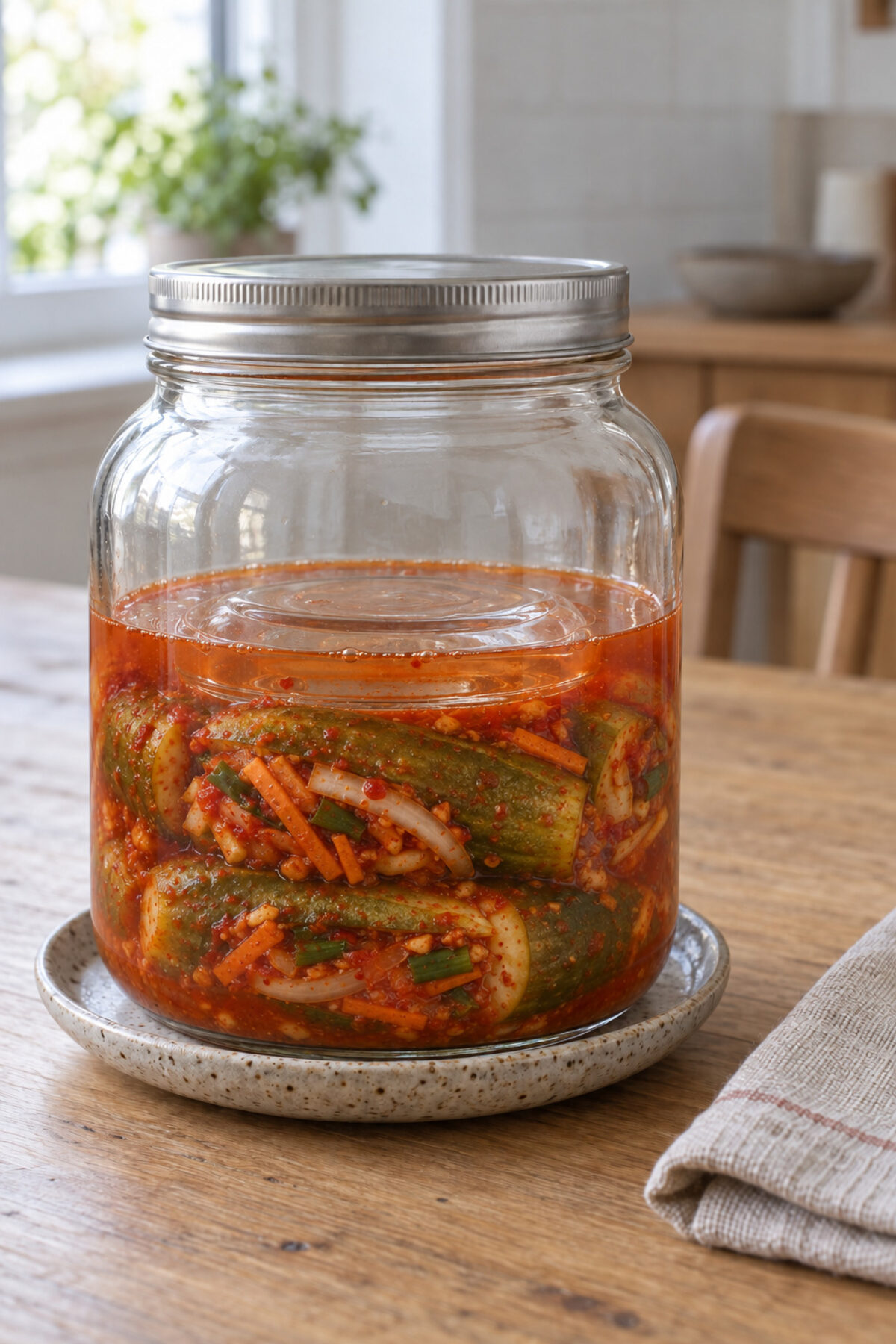
Oi sobagi, stuffed cucumber kimchi
Level 2 · some practice
Small cucumbers split in a cross and stuffed with carrot, onion, green onion and chili. It's summer's kimchi, crunchy at first and the first one to go soft.
- Salt
- 2.5% 25 g per kilo of vegetables
- Time
- 1–2days
- Temperature
- 68–72°F
- Jar
- 2L
The golden rule: never less than 2% salt, into the fridge within a day or two, and not eaten until the pH drops below 4.6: if it doesn't in time, it's thrown out.
No sign-up. We guide you step by step, from the scale to the fridge.
Reviewed October 26, 2026 · 59 facts, each with its source
You'll need
- 2-liter wide-mouth glass jar (about half a gallon)
- Glass weight, or a sealed freezer bag filled with brine
- Airlock lid or a regular lid
- Kitchen scale
- Disposable gloves
- pH strips reading 3 to 5.5, or a pH meter
Step by step
-
Rinse the cucumbers and split them in a cross
Wash your hands with soap for at least 20 seconds. Rinse the cucumbers under running water and trim both ends, especially the blossom end, the one opposite the stem. Cut them into pieces about 3 inches long. Make two lengthwise cuts in each piece, in a cross, stopping short of the end: leave 1/2 inch uncut so it holds together.
Tip: Wash the jar and tools with soap, then submerge them for at least 30 seconds in water at 160 °F or hotter.
-
Salt the cucumbers inside and out and let them sit for 2 hours
Weigh the cut cucumbers and the filling ingredients: the salt goes on the weight of everything, 25 g per kilo. For this recipe that's 25 g. Rub it all over the cucumbers, outside and into the cuts, and let them rest in a bowl for 2 hours, turning them every 30 minutes. They'll give off water and turn pliable, so they open without breaking.
Tip: Don't rinse them or pour off the liquid. That way the kimchi stays at 2.5% salt, inside the 2 to 5% the guides give.
-
Make the filling and stuff the cucumbers
Cut the carrot into thin matchsticks about 1 inch long, the onion into thin strips and the green onions into 1-inch pieces. Finely chop the garlic and ginger and mix them with the gochugaru and a couple of spoonfuls of the liquid from the cucumbers. Wearing gloves, mix this paste with the carrot, onion and green onions. Open each cucumber along its cuts and fill it, without forcing it so hard that it splits.
Tip: Gloves protect your hands from the chili.
-
Lay them in the jar and cover them with the brine
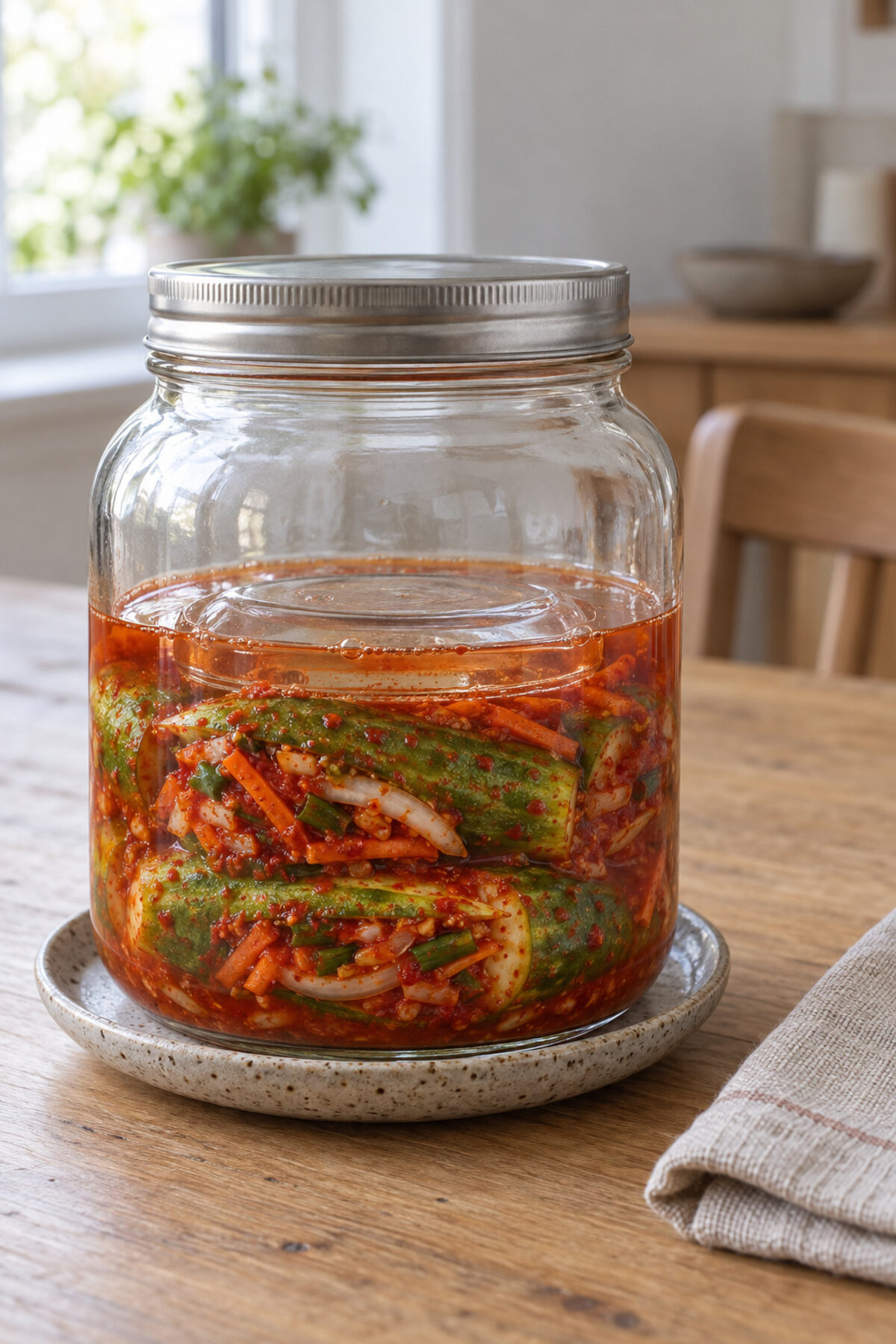
Lay the cucumbers on their sides in the jar, in snug layers. Push any leftover filling into the gaps so there are no air pockets. Pour the liquid from the bowl on top and press until it's covered. Fill the jar to about two-thirds, leaving at least 5 cm (2 in) of headspace: kimchi gives off gas and rises.
Tip: Use glass or food-safe plastic. No metal, and no earthenware with cracks or chips.
-
Add the weight and leave it in the kitchen until the pH drops below 4.6
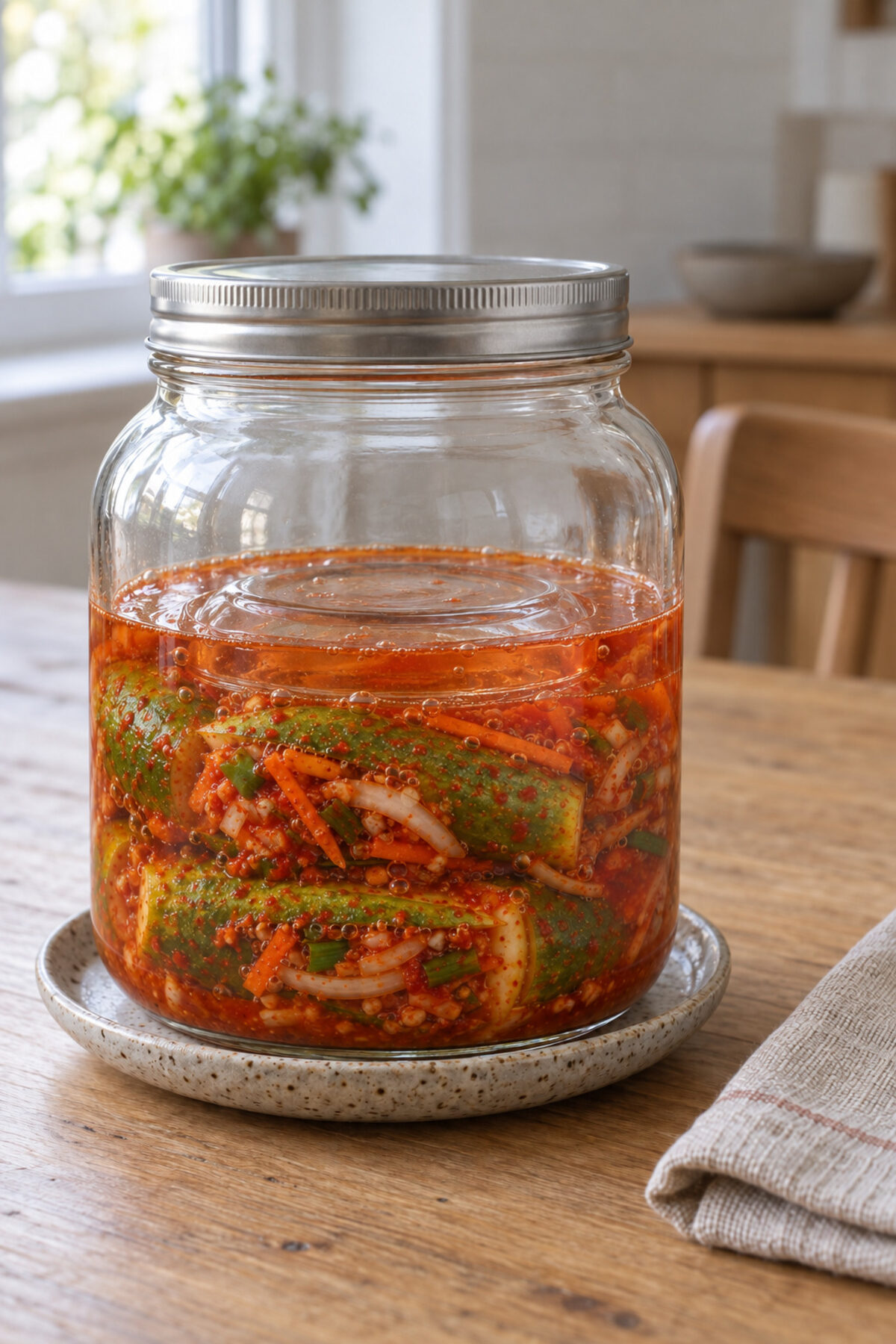
Set the weight so everything stays under the brine and close the jar. With no weight, a zip-top freezer bag filled with brine and sealed does the same: it fits the mouth of the jar and, if it leaks, does not dilute the salt. You can also lay plastic wrap right on the surface, so mould does not form on the top layer. Leave it at 68–72 °F, on a plate in case it overflows. Check every day that it's still submerged. Bubbles are a good sign.
At 24 hours, test the pH of the liquid, then test it again every 12 hours, morning and evening. It usually drops to 4.6 or below within 1 to 2 days. If it's still above 4.6 at 72 hours, the batch has failed: throw it all out.
Close it the way you prefer
- Airlock lid
- Lets the gas out without letting air in: nothing to do.
- Regular lid
- Screw it on but not tight: the gas has to get out, though not so loose that insects or mold spores get in.
Tip: In the first days the pH isn't low enough yet to hold back certain pathogens: that's why you test it. In a cold kitchen, at 64 °F (18 °C) or below, it can take longer than it should: find the warmest spot in the house. With strips, if the color falls between two, go with the higher reading.
-
At pH 4.6 or below, into the fridge
As soon as it reads 4.6 or below, move it to the fridge at 41 °F or below, tightly covered and pressed down under its liquid: there it keeps fermenting slowly. Don't put it in sooner: in the cold, the pH takes about 15 days to drop to 4.6, and the cold holds bacteria back but doesn't get rid of them. By day 5 to 7 it's tangier and softer, and the cucumber is the first thing to lose its crunch. Its optimum is pH 4.2.
From the moment it reads 4.6 or below you can eat it, but the most cautious choice is to wait about 2 weeks in the fridge. That's what BCCDC, British Columbia's public health agency, asks of anyone selling raw kimchi: that time in acid reduces any E. coli there may be.
Tip: Make small batches: cucumber doesn't hold up as long as cabbage and is the first to go soft.
No sign-up. We guide you step by step, from the scale to the fridge.
Variations
The same method, a different flavor. Once you have this one down, try one of these.
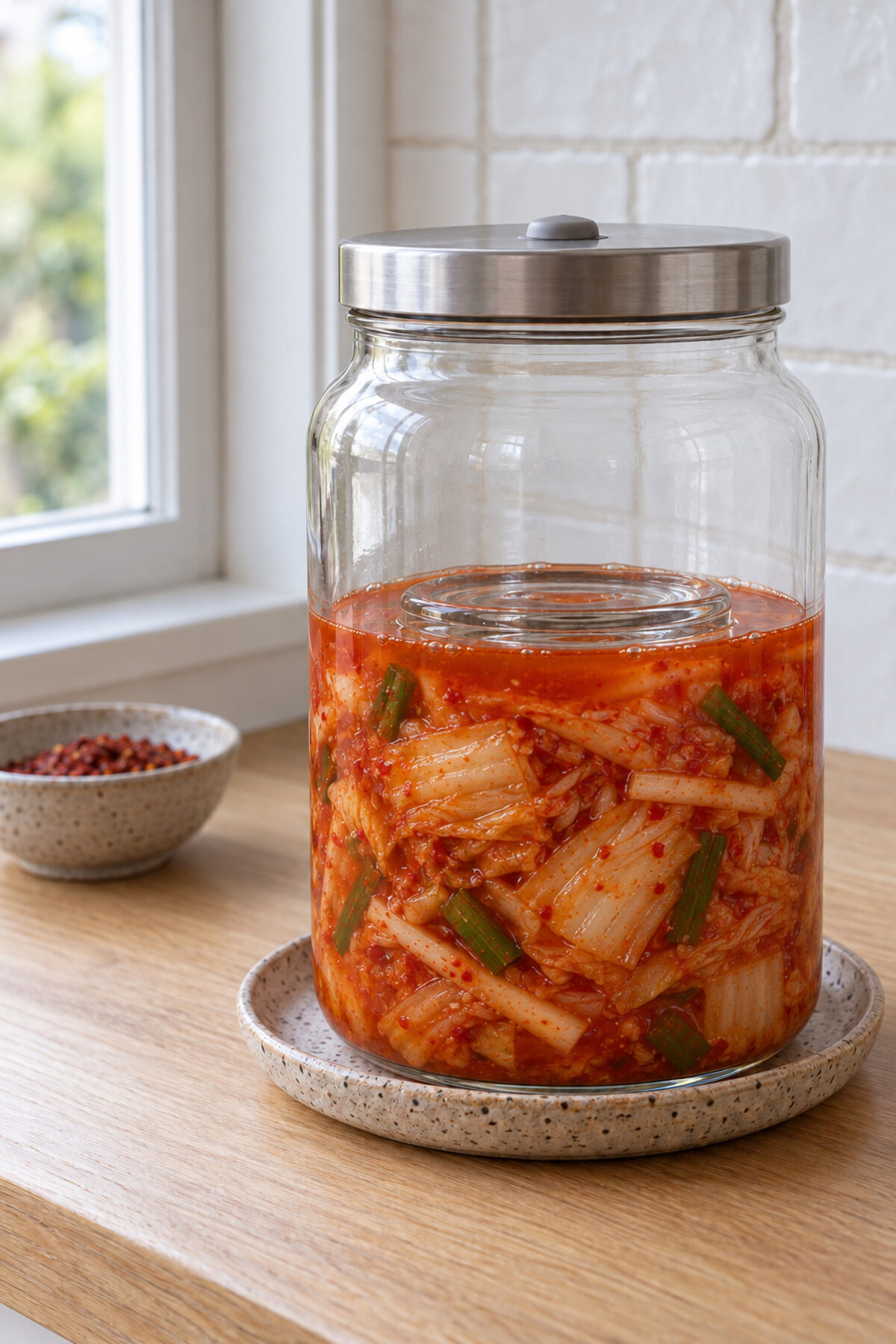

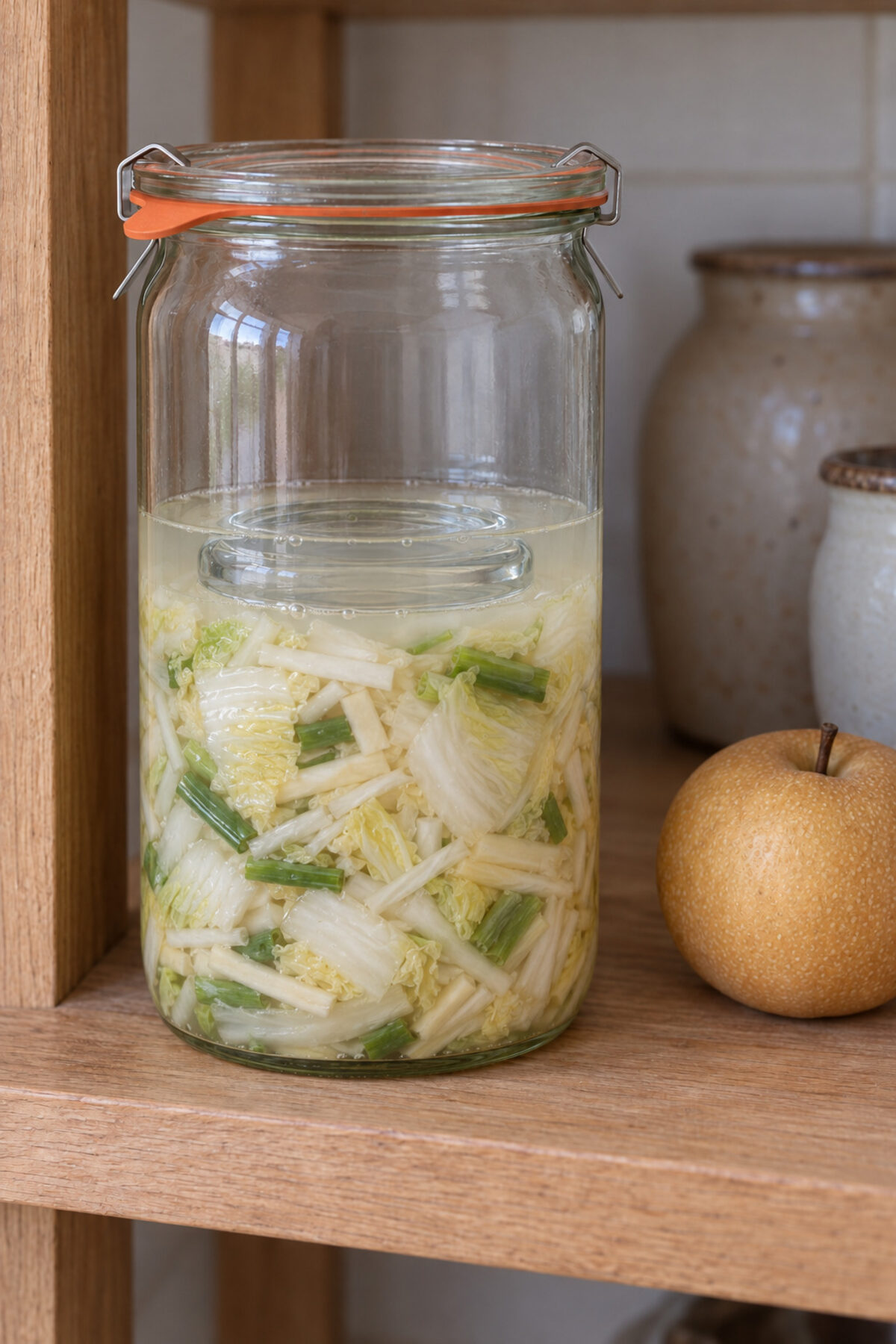
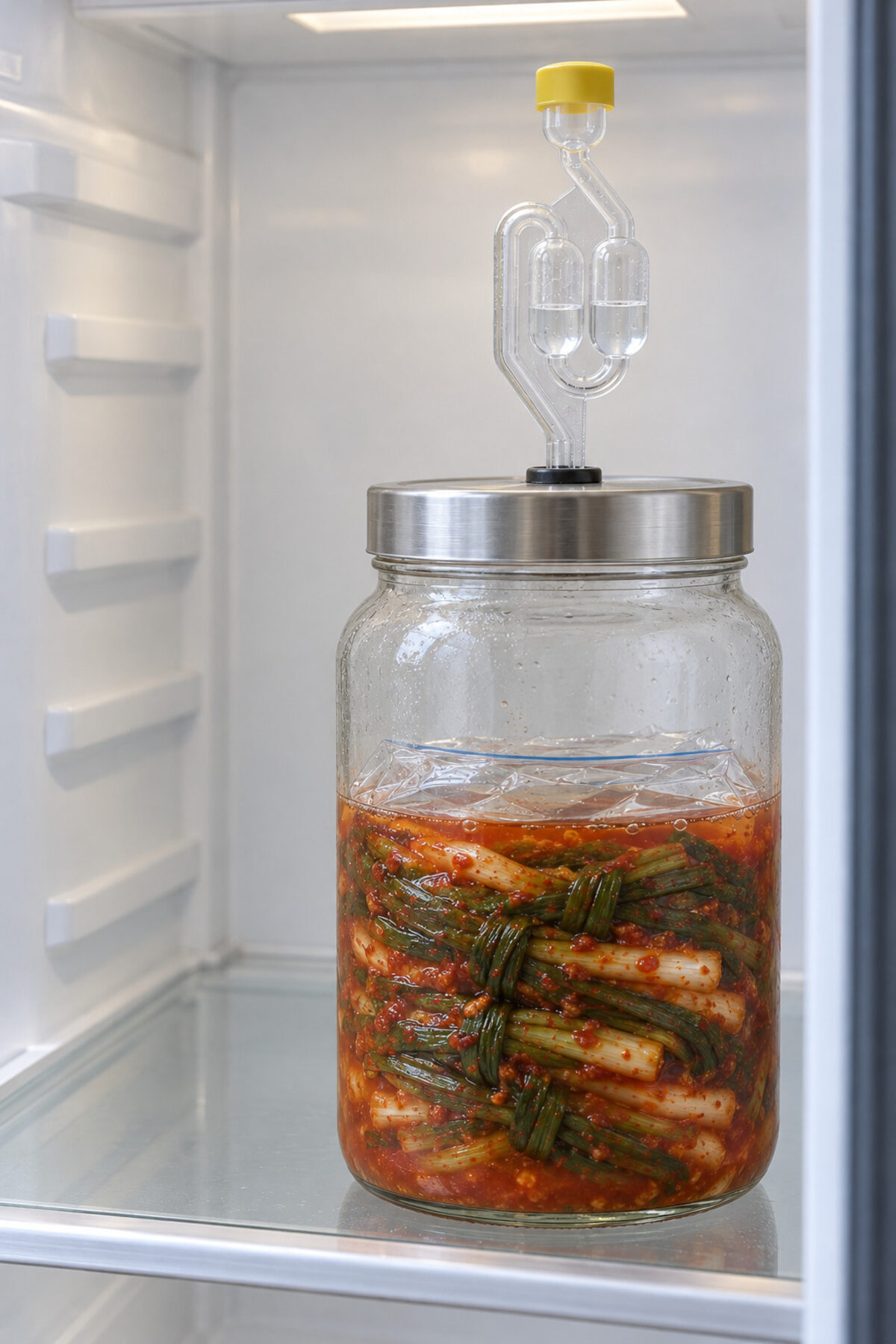
What you'll see
Oi is Korean for cucumber, and sobagi means stuffed. The cucumbers are split in a cross without cutting all the way through, salted and filled with carrot, onion, green onion and chili. It's summer's kimchi, when cucumbers are at their best. In Korea it's often eaten almost fresh; here it ferments like any other kimchi, and it has to reach pH 4.6 or below before it goes into the fridge. The traditional filling has buchu, garlic chives, and sometimes fish sauce; this version is vegetables only and uses green onions, which are easier to find.
 AI
 AI
AI
How to tell it's going well
- Never less than 2% salt, on the weight of all the vegetables. Cutting the salt in a vegetable ferment isn't safe.
- Keep everything under the brine, from start to finish.
- pH 4.6 or below within 72 hours at most. Test it every 12 hours from the first day, with strips or a meter. If it doesn't get there, throw out the batch.
- Into the fridge only once it reads 4.6 or below, at 41 °F or below.
- The most cautious choice: two weeks in the fridge before you start on it.
- Green, blue, brown or black fuzz or spots are mold. Throw out the whole batch; it can't be scooped off.
- Rotten smell or odd texture: throw it out. Good kimchi smells sour, not rotten.
Where every number comes from
Every number in this recipe comes from a food safety guide. We keep a copy of each source and quote its exact words.
-
1
It ferments in 1 to 2 days out of the fridge, more slowly inside
“Kimchi ferments at room temperature in only 1-2 days or more slowly in the refrigerator.”
Oregon State University Extension Service · Preserving Foods: Kimchi Basics (SP 50-1007, March 2020) · read on October 20, 2026
-
2
Press so the liquid covers the cabbage
“pressing down firmly to help liquid cover the cabbage”
Oregon State University Extension Service · Preserving Foods: Kimchi Basics (SP 50-1007, March 2020) · read on October 20, 2026
-
3
Leave at least 5 cm (2 in) of headspace
“Leave at least 2 in. (5 cm) of headspace.”
Oregon State University Extension Service · Preserving Foods: Kimchi Basics (SP 50-1007, March 2020) · read on October 20, 2026
-
4
Between 68 and 72 °F
“Store in a cool (68°F-72°F”
Oregon State University Extension Service · Preserving Foods: Kimchi Basics (SP 50-1007, March 2020) · read on October 20, 2026
-
5
Check every day that it's still submerged
“Check daily to make sure vegetables remain submerged in brine.”
Oregon State University Extension Service · Preserving Foods: Kimchi Basics (SP 50-1007, March 2020) · read on October 20, 2026
-
6
Many recipes use fish sauce, shrimp paste or salted anchovies
“fish sauce, shrimp paste, or salted anchovies are often used to enhance flavor”
University of Georgia Cooperative Extension · Homemade Kimchi: A Science-Based Guide to Safe Fermentation (Circular 1362, 2025) · read on October 20, 2026
-
7
Wash your hands for at least 20 seconds
“Always start by washing your hands with soap and warm water for at least 20 seconds before handling any ingredients.”
University of Georgia Cooperative Extension · Homemade Kimchi: A Science-Based Guide to Safe Fermentation (Circular 1362, 2025) · read on October 20, 2026
-
8
Rinse the cabbage under running water
“Wash the cabbage and other vegetables under running water to remove dirt and surface bacteria.”
University of Georgia Cooperative Extension · Homemade Kimchi: A Science-Based Guide to Safe Fermentation (Circular 1362, 2025) · read on October 20, 2026
Show the remaining 51 claims
-
9
Tools 30 seconds in water at 160 °F or hotter
“wash it with soap and warm water, then submerge it in hot water that is at least 160 °F for at least 30 seconds.”
University of Georgia Cooperative Extension · Homemade Kimchi: A Science-Based Guide to Safe Fermentation (Circular 1362, 2025) · read on October 20, 2026
-
10
Salt it and let it rest 2 hours, massaging every 30 minutes
“rub it with salt and allow it to rest, massaging it every 30 min for 2 hr.”
University of Georgia Cooperative Extension · Homemade Kimchi: A Science-Based Guide to Safe Fermentation (Circular 1362, 2025) · read on October 20, 2026
-
11
Salt draws out the water and makes the brine
“This process draws water out of the cabbage and creates the salty brine needed for fermentation.”
University of Georgia Cooperative Extension · Homemade Kimchi: A Science-Based Guide to Safe Fermentation (Circular 1362, 2025) · read on October 20, 2026
-
12
Packed tight, with no air pockets
“the mixture is packed tightly into jars, minimizing air pockets.”
University of Georgia Cooperative Extension · Homemade Kimchi: A Science-Based Guide to Safe Fermentation (Circular 1362, 2025) · read on October 20, 2026
-
13
Loosely covered, the first 48 hours out of the fridge
“The jars should then be loosely covered and left at room temperature for the first 48 hr.”
University of Georgia Cooperative Extension · Homemade Kimchi: A Science-Based Guide to Safe Fermentation (Circular 1362, 2025) · read on October 20, 2026
-
14
Moving it to the fridge is essential
“it is essential to transfer kimchi to the refrigerator to ensure both flavor development and safety.”
University of Georgia Cooperative Extension · Homemade Kimchi: A Science-Based Guide to Safe Fermentation (Circular 1362, 2025) · read on October 20, 2026
-
15
In the fridge at 41 °F or below
“Maintaining a storage temperature of 41 °F or below helps ensure both the safety and quality of the final product”
University of Georgia Cooperative Extension · Homemade Kimchi: A Science-Based Guide to Safe Fermentation (Circular 1362, 2025) · read on October 20, 2026
-
16
Early on, the pH isn't low enough yet
“During the early stages of fermentation, the pH may not yet be low (acidic) enough to prevent the proliferation of certain pathogens.”
University of Georgia Cooperative Extension · Homemade Kimchi: A Science-Based Guide to Safe Fermentation (Circular 1362, 2025) · read on October 20, 2026
-
17
By day 5 to 7 it tastes tangier
“By days 5 to 7, the kimchi develops a tangier flavor”
University of Georgia Cooperative Extension · Homemade Kimchi: A Science-Based Guide to Safe Fermentation (Circular 1362, 2025) · read on October 20, 2026
-
18
Mold, an off smell or an odd texture are signs of spoilage
“Signs of spoilage include the presence of mold, an off-putting odor distinct from its characteristic fermented aroma, or an unusual texture.”
University of Georgia Cooperative Extension · Homemade Kimchi: A Science-Based Guide to Safe Fermentation (Circular 1362, 2025) · read on October 20, 2026
-
19
If you see any of them, throw it out
“If any of these signs are observed, discard the kimchi to prevent potential foodborne illness.”
University of Georgia Cooperative Extension · Homemade Kimchi: A Science-Based Guide to Safe Fermentation (Circular 1362, 2025) · read on October 20, 2026
-
20
Over the days it gets tangier and softer
“By days 5 to 7, the kimchi develops a tangier flavor, a more pronounced aroma, and a softer texture.”
University of Georgia Cooperative Extension · Homemade Kimchi: A Science-Based Guide to Safe Fermentation (Circular 1362, 2025) · read on October 20, 2026
-
21
Pieces about 2 inches wide
“Chop quarters into 2-inch pieces.”
Colorado State University Extension · Understanding and Making Kimchi (2025) · read on October 20, 2026
-
22
Non-iodized salt
“coarse salt, non-iodized”
Colorado State University Extension · Understanding and Making Kimchi (2025) · read on October 20, 2026
-
23
Final salt ranges from 2 to 5%
“the final salt concentration ranges from 2-5%.”
Colorado State University Extension · Understanding and Making Kimchi (2025) · read on October 20, 2026
-
24
Gloves to protect your hands from the chili
“Disposable food handler gloves (highly recommended) for protection from red pepper powder”
Colorado State University Extension · Understanding and Making Kimchi (2025) · read on October 20, 2026
-
25
Fill to about two-thirds, because it gives off gas
“Fill container about 2/3 of the way full, as fermenting microorganisms will release carbon dioxide (CO2) and create bubbling and fizzing.”
Colorado State University Extension · Understanding and Making Kimchi (2025) · read on October 20, 2026
-
26
No metal and no cracked earthenware
“Do not use metal containers nor earthenware with cracks or chips.”
Colorado State University Extension · Understanding and Making Kimchi (2025) · read on October 20, 2026
-
27
1 to 2 days at room temperature
“around 68°F is ideal. Ferment for 1 to 2 days at room temperature”
Colorado State University Extension · Understanding and Making Kimchi (2025) · read on October 20, 2026
-
28
A plate underneath in case it overflows
“Place on plate or in bowl to catch potential overflow.”
Colorado State University Extension · Understanding and Making Kimchi (2025) · read on October 20, 2026
-
29
The lid not screwed tight, so the gas can escape
“do not over tighten, to allow the carbon dioxide gases to escape.”
Colorado State University Extension · Understanding and Making Kimchi (2025) · read on October 20, 2026
-
30
Before eating, a pH of 4.6 or below
“For safety, kimchi should reach a pH of 4.6 or below before consuming.”
Colorado State University Extension · Understanding and Making Kimchi (2025) · read on October 20, 2026
-
31
A day or two out, testing daily until the pH is 4.6 or below
“Ferment for 1 to 2 days at room temperature, testing it daily until a pH of 4.6 or below is reached.”
Colorado State University Extension · Understanding and Making Kimchi (2025) · read on October 20, 2026
-
32
In the fridge, tightly covered and pressed down
“Store fermented kimchi covered tightly in the refrigerator. Keep it pressed down to minimize air exposure.”
Colorado State University Extension · Understanding and Making Kimchi (2025) · read on October 20, 2026
-
33
The optimum pH is 4.2
“results in an optimum kimchi pH of 4.2.”
Colorado State University Extension · Understanding and Making Kimchi (2025) · read on October 20, 2026
-
34
pH strips reading 3 to 5.5
“To verify pH, use a pH test strip that can test a range of 3.0-5.5 pH.”
Colorado State University Extension · Understanding and Making Kimchi (2025) · read on October 20, 2026
-
35
Nor too loose a lid
“lids should not be too loose to prevent contamination from insects & mold spores.”
Colorado State University Extension · Understanding and Making Kimchi (2025) · read on October 20, 2026
-
36
25 g of salt per kilo of vegetables
“2.5% 25 g / kg food”
UC Master Food Preservers, Inyo-Mono · Brine Math Made Easy · read on October 20, 2026
-
37
Cutting the salt isn't safe
“It is unsafe to reduce salt in lactofermented vegetables.”
UC Master Food Preservers, Inyo-Mono · Brine Math Made Easy · read on October 20, 2026
-
38
2.5% final salt in the standard recipe
“and the final salt concentration 2.5 in the proportion of 100 salted chinese cabbage.”
Korean Journal of Food Science and Technology (Cho, Park & Rhee), via KoreaScience (KISTI) · Standardization of Ingredient Ratios of Chinese Cabbage Kimchi (1997), abstract · read on October 20, 2026
-
39
Bubbles are a good sign
“Some fermentation microbes make carbon dioxide gas during the fermentation process. This can be a good sign”
UC Davis, Department of Food Science and Technology · Common issues with fermented fruits and vegetables (v1.0, 15-mar-2022) · read on October 20, 2026
-
40
Everything under the brine
“All produce should be submerged in the brine liquid.”
UC Davis, Department of Food Science and Technology · Common issues with fermented fruits and vegetables (v1.0, 15-mar-2022) · read on October 20, 2026
-
41
Mold is usually green, blue, brown or black
“Mold is typically green, blue, brown, or black in color.”
UC Davis, Department of Food Science and Technology · Common issues with fermented fruits and vegetables (v1.0, 15-mar-2022) · read on October 20, 2026
-
42
If there's mold, the whole batch goes
“If you confirm mold growth on any part of a ferment, it should be immediately discarded.”
UC Davis, Department of Food Science and Technology · Common issues with fermented fruits and vegetables (v1.0, 15-mar-2022) · read on October 20, 2026
-
43
It smells pleasantly sour, not putrid
“A fermented fruit or vegetable will smell pleasantly sour but not putrid.”
UC Davis, Department of Food Science and Technology · Common issues with fermented fruits and vegetables (v1.0, 15-mar-2022) · read on October 20, 2026
-
44
The pH of the liquid, every 12 hours until it reaches 4.6
“Brine pH is measured every 12h until pH reaches 4.6.”
BC Centre for Disease Control, Environmental Health Services · Safety of Fermented Foods, Section 3.3: Kimchi (2024) · read on October 26, 2026
-
45
At 64–72 °F (18–22 °C), the pH should drop to 4.6 or below within 2 days (48 hours)
“at room temperature (18oC to 22oC), a pH drop to 4.6 or lower should occur with 2 days (48 hours).”
BC Centre for Disease Control, Environmental Health Services · Safety of Fermented Foods, Section 3.3: Kimchi (2024) · read on October 26, 2026
-
46
If it hasn't reached 4.6 by 72 hours, the batch is discarded
“If a pH drop to 4.6 or lower is not achieved within a maximum of 3 days (72 hours) the batch should be discarded”
BC Centre for Disease Control, Environmental Health Services · Safety of Fermented Foods, Section 3.3: Kimchi (2024) · read on October 26, 2026
-
47
At 64 °F (18 °C) the pH may take longer to drop
“At lower room temperature (18oC) it may take longer for pH to drop than the critical limits proposed below.”
BC Centre for Disease Control, Environmental Health Services · Safety of Fermented Foods, Section 3.3: Kimchi (2024) · read on October 26, 2026
-
48
A pH of 4.6 or below before it goes into the fridge
“pH is ≤4.6 before packaging & refrigeration”
BC Centre for Disease Control, Environmental Health Services · Safety of Fermented Foods, Section 3.3: Kimchi (2024) · read on October 26, 2026
-
49
The pH drops to 4.6 in about 2 days at 68 °F, 6 at 50 °F, 15 at 41 °F and 35 at 32 °F
“pH drops to approximately 4.6 or lower in 2 days at 20oC, 6 days at 10oC, 15 days at 5oC and 35 days at 0oC.”
BC Centre for Disease Control, Environmental Health Services · Safety of Fermented Foods, Section 3.3: Kimchi (2024) · read on October 26, 2026
-
50
Once the pH is down, at least two weeks in the fridge before it's sold
“operators are recommended to keep and hold product for a minimum of two weeks under refrigeration following fermentation once pH levels drop.”
BC Centre for Disease Control, Environmental Health Services · Safety of Fermented Foods, Section 3.3: Kimchi (2024) · read on October 26, 2026
-
51
That time in acid reduces any E. coli there may be
“This holding time period will allow for acids present in the kimchi to reduce E.coli (if present).”
BC Centre for Disease Control, Environmental Health Services · Safety of Fermented Foods, Section 3.3: Kimchi (2024) · read on October 26, 2026
-
52
Store-bought kimchi usually carries a best-before of about two months
“Commercial companies generally provide best before dates of approximately two months on products.”
BC Centre for Disease Control, Environmental Health Services · Safety of Fermented Foods, Section 3.3: Kimchi (2024) · read on October 26, 2026
-
53
Plastic wrap on the kimchi keeps mould off the top layer
“Plastic wrap may be placed over the kimchi to prevent mould forming on the top layer.”
BC Centre for Disease Control, Environmental Health Services · Safety of Fermented Foods, Section 3.3: Kimchi (2024) · read on October 26, 2026
-
54
At 39 °F (4 °C), E. coli and Listeria don't grow, but they stay
“the populations of foodborne pathogens did not increase at the initial stage of fermentation at 4 °C but instead remained”
Kim JY, Bae YM, Lee SY (Chung-Ang University), Food Science and Biotechnology · Combined effect of various salt concentrations and lactic acid bacteria fermentation on the survival of Escherichia coli O157:H7 and Listeria monocytogenes in white kimchi at different temperatures (2021) · read on October 27, 2026
-
55
Mold can't be scooped off
“The mold cannot be scooped out, as the roots will still be in your food and could make you sick.”
Ask Extension (Clackamas County Extension, Oregon State University) · Pickle/olive brine surface mold spots #889210 · read on October 20, 2026
-
56
The airlock lets the gas out
“it is important to vent the jar with a one-way valve to release the gases that form during fermentation.”
K-State Research and Extension (Kansas State University) · Taking a New Look at Fermented Foods (MF3491, June 2020) · read on October 20, 2026
-
57
The bag holds brine: if it leaks, the salt is not diluted
“It is recommended that the brine solution be stored in plastic bags to ensure that the fermentation brine is not diluted should the bag leak or break.”
Virginia Cooperative Extension (Virginia Tech) · Vegetable fermentation (FST-328, reviewed 2025) · read on October 26, 2026
-
58
The bag, well sealed
“Be sure to seal the plastic bag.”
National Center for Home Food Preservation (USDA, University of Georgia) · Suitable Containers, Covers, and Weights for Fermenting Food · read on October 26, 2026
-
59
Cut off the cucumber's blossom end
“Wash cucumbers, cut off blossom end.”
BC Centre for Disease Control, Environmental Health Services · Safety of Fermented Foods, Section 3.1: Fermented Vegetables (August 2024, updated December 2024) · read on October 25, 2026