






The top has darkened
The short answer It depends on what you see
It depends what it looks like: if it's fuzzy or spotted, it's mold and everything goes. If it's only a darker shade, flat, and smells sour, it comes from air, heat, light or salt: cover it again, check the pH if you can and fix the cause.
Reviewed October 26, 2026 · 19 facts, each with its source
 AI
When in doubt, throw it out. Fervida can’t see your jar. No page can tell you something is safe: it can show you how to look.
What you see
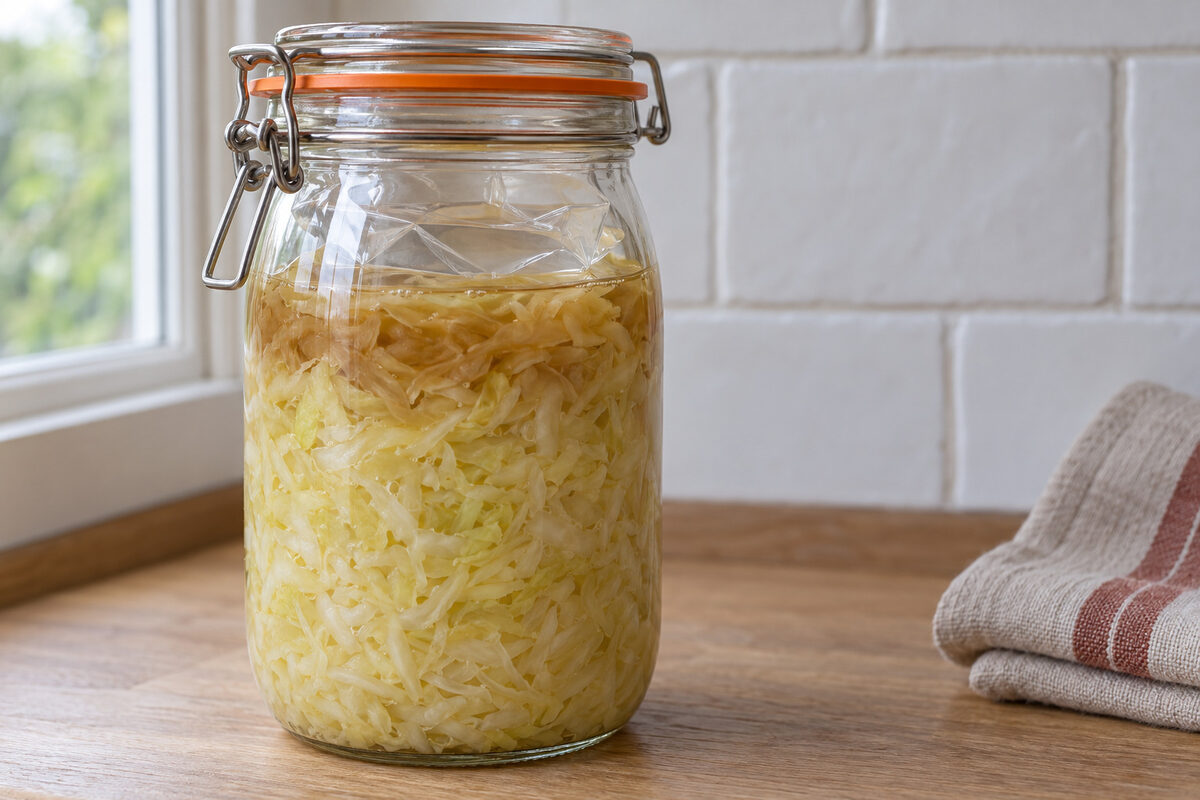
The top layer in the jar, the one closest to the air, is darker than the rest: toasted yellow, brown or grayish. Below it, the vegetables keep their color. In red cabbage, the top can turn from red or pink back to purple.
First of all, check whether it's raised. A patch with fuzz or dots isn't a color change: it's mold.
Why it happens
What's on top is what touches the air most, especially if vegetables poke out or the brine has dropped, and in the air the yeasts and molds that spoil a ferment grow. On top of that, the guides link dark sauerkraut to:
- Not using canning or pickling salt, or spreading it unevenly.
- Cabbage that wasn't trimmed, with its outer leaves left on.
- Too much heat while fermenting or in storage, or storing it a long time.
- Light.
- Brass, copper or zinc utensils.
In red cabbage, the color follows the acidity. If the top turns back to purple, the pH may have risen there, for example because mold has grown.
What to do
It depends what it looks like
- Fuzz or spots that are green, blue, brown or black: it's mold. Throw out the whole batch; it can't be scooped off.
- Smells rotten or feels slimy: throw it out.
- You used brass, copper or zinc utensils or containers: don't eat it.
- Only a darker shade, flat, and it smells sour: press the vegetables back under the brine and, if liquid is missing, top up with boiled and cooled brine with the same proportion of salt as the recipe. Move the jar somewhere dark. If you have strips or a pH meter, check the pH: it must not rise above 4.6.
When in doubt, throw it out.
How to prevent it
- Canning or pickling salt, mixed well into the cabbage and dissolved before packing.
- Remove the outer leaves and rinse the cabbage before shredding it.
- Every vegetable below the brine.
- Ferment at 70–75 °F (21–24 °C), somewhere dark.
- Glass, stainless steel or unchipped enamel utensils.
Where every figure comes from
Every statement on this page comes from a food safety guide. We keep a copy of each source and quote its exact words, in its original language.
-
1
Vegetables poking out of the brine spoil
“Fermenting vegetables may float to the surface and poke up out of the brine where they may spoil.”
K-State Research and Extension (Kansas State University) · Taking a New Look at Fermented Foods (MF3491, June 2020) · read on October 20, 2026
-
2
In the air, yeasts and molds grow that spoil the ferment
“When oxygen is not excluded, aerobic environments at the surface will allow growth of aerobic yeasts and moulds, causing spoilage.”
BC Centre for Disease Control, Environmental Health Services · Safety of Fermented Foods, Section 3.1: Fermented Vegetables (August 2024, updated December 2024) · read on October 25, 2026
-
3
Sauerkraut darkens from salt, untrimmed cabbage, heat, time or light
“Dark kraut Canning/pickling salt was not used. Cabbage was not trimmed and washed properly. Uneven salting. Too high temperature during fermentation. Too warm storage conditions or stored for long period. Stored in a light location.”
Oregon State University Extension Service · Sauerkraut: Problems and solutions · read on October 26, 2026
-
4
Ferment in a dark place
“Ferment in a dark location.”
Oregon State University Extension Service · Sauerkraut: Problems and solutions · read on October 26, 2026
-
5
Mix the salt in well and let it dissolve before packing
“Mix cabbage with salt well and make sure salt is completely dissolved before packing.”
Oregon State University Extension Service · Sauerkraut: Problems and solutions · read on October 26, 2026
-
6
Remove the outer leaves and rinse the cabbage before shredding
“Discard outer leaves and rinse in cool water before shredding.”
Oregon State University Extension Service · Sauerkraut: Problems and solutions · read on October 26, 2026
-
7
Ferment sauerkraut at 70–75 °F
“Keep sauerkraut between 70°F and 75°F during fermenting.”
Oregon State University Extension Service · Sauerkraut: Problems and solutions · read on October 26, 2026
-
8
If brass, copper or zinc utensils were used, don't eat it
“Dark or discolored pickles. (If brass, copper or zinc utensils and brining equipment were used, do not use pickles.)”
National Center for Home Food Preservation (USDA, University of Georgia) · Causes and Possible Solutions for Problems with Fermented Pickles · read on October 26, 2026
Show the remaining 11 claims
-
9
Glass, stainless steel or unchipped enamel utensils
“Use food-grade unchipped enamelware, glass, stainless steel, or stoneware utensils.”
National Center for Home Food Preservation (USDA, University of Georgia) · Causes and Possible Solutions for Problems with Fermented Pickles · read on October 26, 2026
-
10
Mold is usually green, blue, brown or black
“Mold is typically green, blue, brown, or black in color.”
UC Davis, Department of Food Science and Technology · Common issues with fermented fruits and vegetables (v1.0, 15-mar-2022) · read on October 20, 2026
-
11
If there is mold anywhere, the whole batch goes
“If you confirm mold growth on any part of a ferment, it should be immediately discarded.”
UC Davis, Department of Food Science and Technology · Common issues with fermented fruits and vegetables (v1.0, 15-mar-2022) · read on October 20, 2026
-
12
A rotten smell means a failed ferment
“A putrid smell indicates a failed fermentation.”
UC Davis, Department of Food Science and Technology · Common issues with fermented fruits and vegetables (v1.0, 15-mar-2022) · read on October 20, 2026
-
13
Every vegetable below the brine
“All produce should be submerged in the brine liquid.”
UC Davis, Department of Food Science and Technology · Common issues with fermented fruits and vegetables (v1.0, 15-mar-2022) · read on October 20, 2026
-
14
The pH must not rise above 4.6
“The pH can be checked periodically to ensure it does not rise above 4.6.”
UC Davis, Department of Food Science and Technology · Common issues with fermented fruits and vegetables (v1.0, 15-mar-2022) · read on October 20, 2026
-
15
In red cabbage, mold raises the pH and the color turns back to purple
“White mold growth on sauerkraut stored outside brine, causing it to change color to purple instead of red due to an increase in pH”
UC Davis, Department of Food Science and Technology · Common issues with fermented fruits and vegetables (v1.0, 15-mar-2022) · read on October 20, 2026
-
16
Mold can't be scooped out: its roots stay in the food
“The mold cannot be scooped out, as the roots will still be in your food and could make you sick.”
Ask Extension (Clackamas County Extension, Oregon State University) · Pickle/olive brine surface mold spots #889210 · read on October 20, 2026
-
17
If it's slimy or smells rotten, throw it out
“If fermented product is slimy, smells spoiled/rotten, discard it.”
University of Illinois Extension · Fermentation handout (2020) · read on October 20, 2026
-
18
When in doubt, throw it out
“When in Doubt—Throw it Out”
University of Illinois Extension · Fermentation handout (2020) · read on October 20, 2026
-
19
If the juice doesn't cover them, add boiled and cooled brine
“If juice does not cover cabbage, add boiled and cooled brine (1-1/2 tablespoons of salt per quart of water).”
National Center for Home Food Preservation (USDA, University of Georgia) · Sauerkraut · read on October 20, 2026