






Slimy water kefir
The short answer It depends on what you see
It depends on the smell and the pH. Some body is normal: the grains make dextran, which thickens the drink. If it smells sour and fruity and the pH reaches 4.6 or below within 2–4 days, that's most likely what it is. If it smells rotten, has mold or the pH doesn't drop, throw it all out, grains included.
Reviewed October 26, 2026 · 17 facts, each with its source
 AI
When in doubt, throw it out. Fervida can’t see your jar. No page can tell you something is safe: it can show you how to look.
What you see
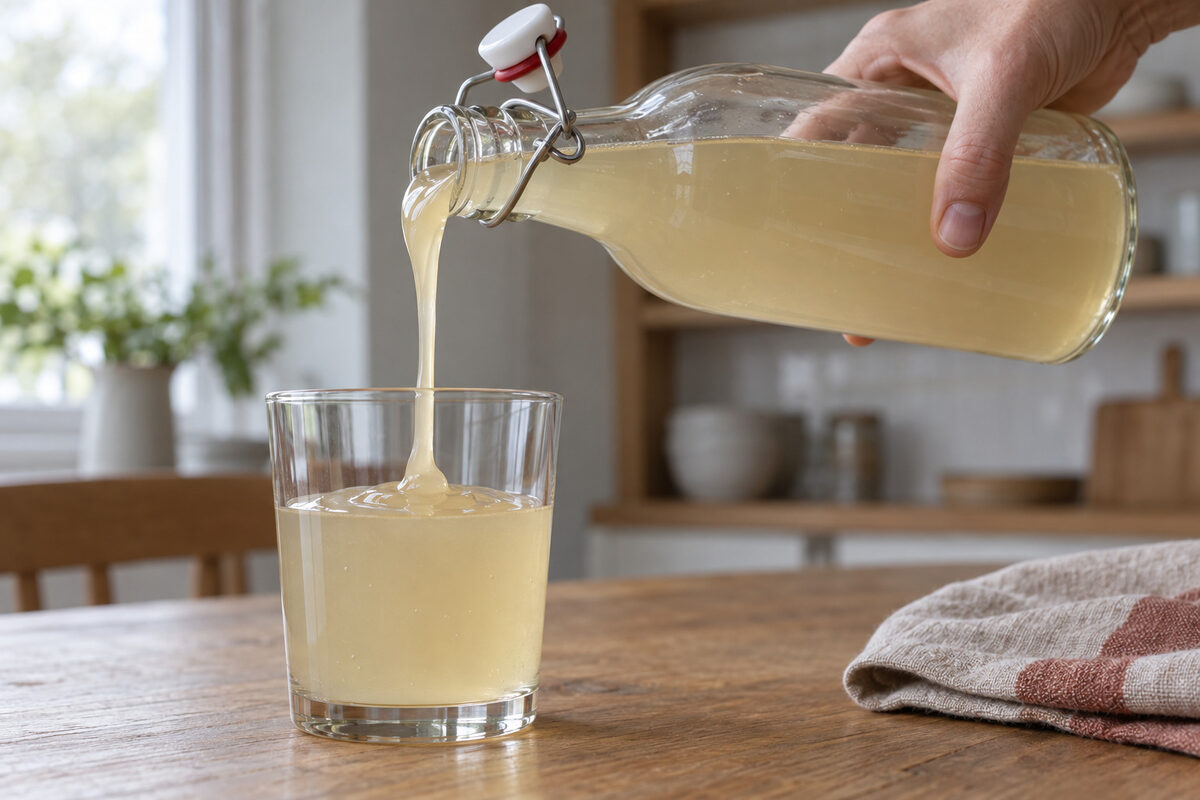
The water kefir pours thicker than usual, sometimes in strings, or has a gel-like texture. It feels slick in your mouth.
Why it happens
The main polysaccharide in water kefir grains is dextran, made by one of their bacteria, Lentilactobacillus hilgardii. It ends up in the drink too. That's why water kefir usually has some body: depending on how long it ferments and the microbes in each set of grains, it ranges from thin and watery to slightly thick and gel-like.
But not everything slimy is dextran. Kefir can get contaminated during fermentation, or through poor hygiene with the ingredients or equipment. And a base without enough fruit or sugar ferments slowly, the pH stays high and pathogens can grow. What tells the two apart is the smell and the pH.
What to do
It depends on the smell and the pH
If it smells sour and fruity, and the pH reached 4.6 or below within 2–4 days, it's most likely the dextran. It's a matter of taste. If you don't like it that thick, try straining it sooner next time: fermentation time is one of the things that changes the texture.
If the pH hasn't reached 4.6 by 96 hours, the batch has failed: throw it out.
If it smells rotten or has mold, throw it all out, grains included.
Check the grains too. If they grow slowly, change color or smell, or stop fermenting, throw them out and start over with new grains.
When in doubt, throw it out.
How to prevent it
- At 68–77 °F (20–25 °C). Taste it from 24 hours on, and test the pH before 96.
- The base, boiled with its fruit and sugar, with no more than 100 g of sugar per liter. Without fruit or sugar, it ferments slowly.
- About 50 g of grains per liter, 5%, and active.
- The strainer sanitized before each use, and all your equipment clean.
- Mineral water: not distilled, reverse osmosis, carbon-filtered or chlorinated tap water.
Where every figure comes from
Every statement on this page comes from a food safety guide. We keep a copy of each source and quote its exact words, in its original language.
-
1
Water kefir usually has some body; it ranges from thin and watery to slightly thick and gel-like, depending on time and microbes
“Water kefir typically has a slightly viscous texture due to the polysaccharides produced during fermentation. The texture can range from thin and watery to slightly thicker and gel-like, depending on factors such as fermentation time and strain selection”
Heliyon (Elsevier), open access via PubMed Central · Challenges in water kefir production and limitations in human consumption: A comprehensive review of current knowledge (2024) · read on October 25, 2026
-
2
A bacterium in the grains makes dextran, the main polysaccharide of the grains and the drink
“Lentilactobacillus hilgardii produces a homopolysaccharide, dextran, which is the predominant exopolysaccharide of water kefir grains and water kefir beverages”
Heliyon (Elsevier), open access via PubMed Central · Challenges in water kefir production and limitations in human consumption: A comprehensive review of current knowledge (2024) · read on October 25, 2026
-
3
It can get contaminated during fermentation or through poor hygiene with the ingredients or equipment
“Contamination can occur during the fermentation process or through inadequate hygiene practices in handling the ingredients or equipment.”
Heliyon (Elsevier), open access via PubMed Central · Challenges in water kefir production and limitations in human consumption: A comprehensive review of current knowledge (2024) · read on October 25, 2026
-
4
5 to 10% grains and sugar, at 68–77 °F, for 24 to 72 hours
“Traditionally, water kefir is prepared by the addition of 5–10 % (w/v) of water kefir grains in 5–10 % (w/v) sucrose solution, followed by fermentation at room temperature of 20–25 °C in anaerobic conditions for 24–72 h”
Heliyon (Elsevier), open access via PubMed Central · Challenges in water kefir production and limitations in human consumption: A comprehensive review of current knowledge (2024) · read on October 25, 2026
-
5
After 2–4 days, a fizzy drink that's fruity, sour, slightly sweet and slightly alcoholic
“After 2 to 4 days of anaerobic incubation at room temperature, a sparkling, yellowish fermented beverage is obtained that has a fruity, acidic, slightly sweet, and slightly alcoholic taste and aroma.”
Applied and Environmental Microbiology (Laureys & De Vuyst), via PubMed Central · Microbial species diversity, community dynamics, and metabolite kinetics of water kefir fermentation (2014) · read on October 25, 2026
-
6
Without enough fruit or sugar, it ferments slowly, the pH stays high and pathogens can grow
“Low nutrient concentration (i.e., absence of fruits or added sugars) in the starting mixture can slow fermentation, resulting in lower metabolic activity of kefir grain culture, higher kefir pH and create potential for pathogenic growth.”
BC Centre for Disease Control, Environmental Health Services · Safety of Fermented Foods, Section 3.12: Kefir, milk and water (December 2024) · read on October 25, 2026
-
7
pH 4.6 or below within 2 to 4 days
“a pH of 4.6 or lower should be verified, regardless within 2 to 4 days (48-96 hrs).”
BC Centre for Disease Control, Environmental Health Services · Safety of Fermented Foods, Section 3.12: Kefir, milk and water (December 2024) · read on October 25, 2026
-
8
pH 4.6 or below, never below 2.5
“Ensure the pH of final product is 4.6 or less, but not lower than pH of 2.5.”
BC Centre for Disease Control, Environmental Health Services · Safety of Fermented Foods, Section 3.12: Kefir, milk and water (December 2024) · read on October 25, 2026
Show the remaining 9 claims
-
9
If the grains grow slowly, change color or smell, or stop fermenting, they go
“If kefir grains grow slowly, if the grains develop unusual colour, odour, or if grains lose activity, grain function is compromised, and they should be discarded.”
BC Centre for Disease Control, Environmental Health Services · Safety of Fermented Foods, Section 3.12: Kefir, milk and water (December 2024) · read on October 25, 2026
-
10
The base, boiled or pasteurized
“Heat to boiling and/or pasteurize water, juice, added sugars and fruits to achieve a 5-log reduction (e.g., to 85oC for 16 sec or equivalent).”
BC Centre for Disease Control, Environmental Health Services · Safety of Fermented Foods, Section 3.12: Kefir, milk and water (December 2024) · read on October 25, 2026
-
11
No more than 10% sugar
“Add up to 10% w/v sucrose (sugar) along with dried fruits (e.g., figs) or juice extracts.”
BC Centre for Disease Control, Environmental Health Services · Safety of Fermented Foods, Section 3.12: Kefir, milk and water (December 2024) · read on October 25, 2026
-
12
Active grains, around 5%
“Kefir grains must be activated (active), and sufficient grains added (approx. 5% w/v).”
BC Centre for Disease Control, Environmental Health Services · Safety of Fermented Foods, Section 3.12: Kefir, milk and water (December 2024) · read on October 25, 2026
-
13
The strainer, sanitized before each use
“Sanitize sieves before each use.”
BC Centre for Disease Control, Environmental Health Services · Safety of Fermented Foods, Section 3.12: Kefir, milk and water (December 2024) · read on October 25, 2026
-
14
Not distilled, reverse osmosis, carbon-filtered or chlorinated tap water
“As trace minerals are required by the kefir grains, use of reverse osmosis, carbon filtered, and distilled water was not recommended, as was use of tap water containing chlorine or fluorides”
BC Centre for Disease Control, Environmental Health Services · Safety of Fermented Foods, Section 3.12: Kefir, milk and water (December 2024) · read on October 25, 2026
-
15
A putrid smell means a failed fermentation
“A putrid smell indicates a failed fermentation.”
UC Davis, Department of Food Science and Technology · Common issues with fermented fruits and vegetables (v1.0, 15-mar-2022) · read on October 20, 2026
-
16
Green, blue, brown or black mold goes
“If you confirm mold growth on any part of a ferment, it should be immediately discarded. Mold is typically green, blue, brown, or black in color.”
UC Davis, Department of Food Science and Technology · Common issues with fermented fruits and vegetables (v1.0, 15-mar-2022) · read on October 20, 2026
-
17
When in doubt, throw it out
“When in Doubt—Throw it Out”
University of Illinois Extension · Fermentation handout (2020) · read on October 20, 2026