






The lid is bulging
The short answer It depends on what you see
It depends on what's in the jar. On an active vegetable ferment it's fermentation gas: loosen the lid to let it out. On a sealed preserve that shouldn't be fermenting, homemade or store-bought, it's a warning sign: throw it out without tasting it.
Reviewed October 26, 2026 · 16 facts, each with its source
 AI
When in doubt, throw it out. Fervida can’t see your jar. No page can tell you something is safe: it can show you how to look.
What you see
The lid of a jar is domed outward and, if you press the center, it gives or clicks. When you open it, it hisses or spurts.
Why it happens
There's gas inside. What matters is where it comes from, and that depends on what's in the jar.
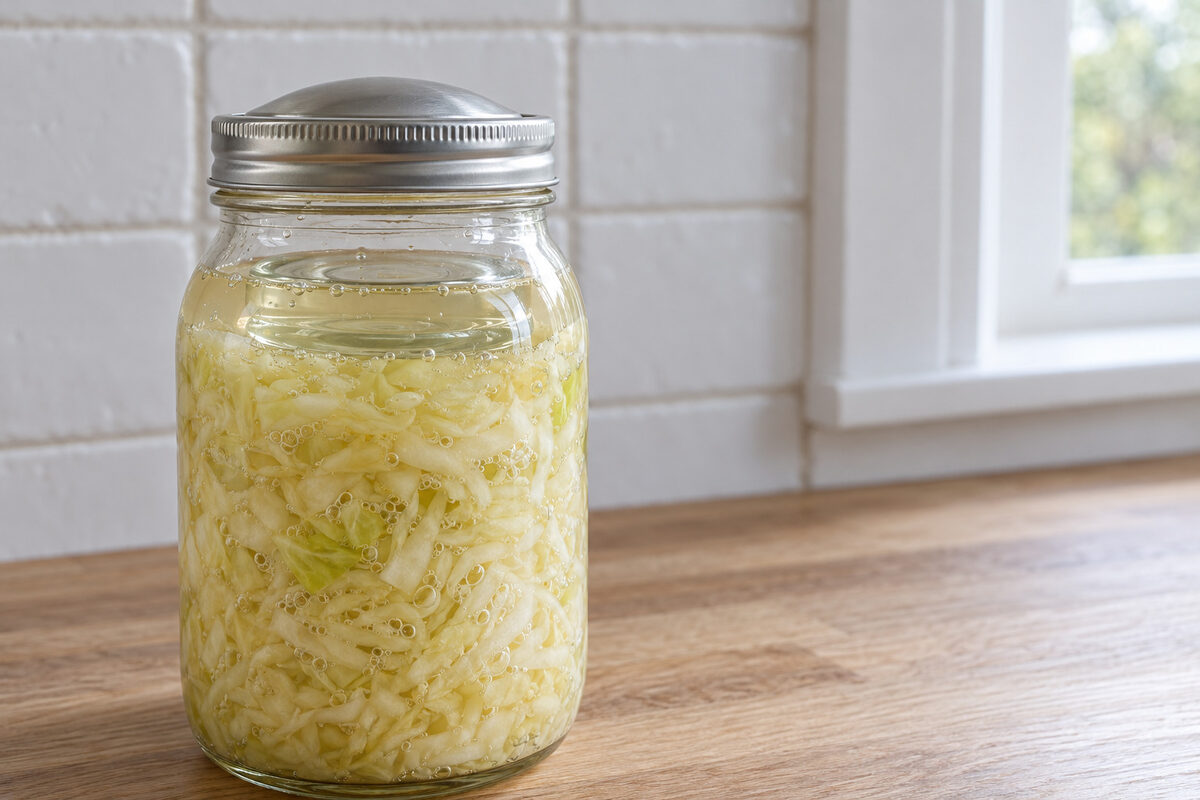
An active vegetable ferment, like sauerkraut, kimchi or pickles. Bacteria give off gas as they ferment, and with the lid closed it builds up. It's a good sign, as long as the pH ends up below 4.6. In the fridge fermentation slowly continues, so it can happen there too.
A sealed preserve that shouldn't be fermenting: a jar you canned at home, including sauerkraut you already jarred and processed, or a store-bought can or jar. No gas should form in there. A bulging lid is one of the signs that it may be contaminated, botulinum toxin included. Home-canned vegetables are the most common cause of botulism outbreaks in the United States.
What to do
It depends on what's in the jar
If it's an active vegetable ferment:
- Loosen the lid briefly to let the gas out, then close it again. Or fit an airlock.
- Look at the surface and smell it. If there's mold or it smells rotten, throw out the whole batch.
- If you have strips or a pH meter, the pH has to reach 4.6 or lower.
If it's a sealed preserve, homemade or store-bought: throw it out. Don't taste it, not even a little: the toxin can't be seen, smelled or tasted, and even a small taste can be deadly.
If it's garlic in honey with a bulging lid or bubbles, it is fermenting, but it isn't a salted vegetable ferment. See "Garlic honey and botulism".
If it's bottled kombucha, the gas builds up and the bottles can explode. See "Exploding bottles".
If you're not sure which case you're in, throw it out. If someone has already tasted it, see "What if I already ate some?".
How to prevent it
- For ferments, an airlock, or opening the lid briefly now and then to let the gas out.
- Preserves of fresh vegetables that aren't fermented or acidified, only in a pressure canner: it's the only recommended method for low-acid foods.
Where every figure comes from
Every statement on this page comes from a food safety guide. We keep a copy of each source and quote its exact words, in its original language.
-
1
Fermentation gas is a good sign, as long as the pH stays below 4.6
“Some fermentation microbes make carbon dioxide gas during the fermentation process. This can be a good sign, but only if the pH stays below pH 4.6”
UC Davis, Department of Food Science and Technology · Common issues with fermented fruits and vegetables (v1.0, 15-mar-2022) · read on October 20, 2026
-
2
Open the lid now and then to let the gas out
“periodically “burp” your vessel (i.e. open the lid) to release the gas.”
UC Davis, Department of Food Science and Technology · Common issues with fermented fruits and vegetables (v1.0, 15-mar-2022) · read on October 20, 2026
-
3
A rotten smell means a failed ferment
“A putrid smell indicates a failed fermentation.”
UC Davis, Department of Food Science and Technology · Common issues with fermented fruits and vegetables (v1.0, 15-mar-2022) · read on October 20, 2026
-
4
If there is mold anywhere, the whole batch goes
“If you confirm mold growth on any part of a ferment, it should be immediately discarded.”
UC Davis, Department of Food Science and Technology · Common issues with fermented fruits and vegetables (v1.0, 15-mar-2022) · read on October 20, 2026
-
5
Without a valve, the gas is let out by loosening the lid now and then
“If a one-way valve is not used, the gases will need to be released manually by loosening the lid occasionally.”
K-State Research and Extension (Kansas State University) · Taking a New Look at Fermented Foods (MF3491, June 2020) · read on October 20, 2026
-
6
A valve lets the fermentation gases out
“it is important to vent the jar with a one-way valve to release the gases that form during fermentation.”
K-State Research and Extension (Kansas State University) · Taking a New Look at Fermented Foods (MF3491, June 2020) · read on October 20, 2026
-
7
In the fridge the process slowly continues
“Expect subtle changes in flavor even during refrigeration (the process slowly continues).”
University of Illinois Extension · Fermentation handout (2020) · read on October 20, 2026
-
8
A bulging or swollen container is a sign that home-canned or store-bought food may be contaminated
“Any of the following signs indicate that home-canned and store-bought food might be contaminated with toxins or harmful germs. The container is leaking, bulging, or swollen”
CDC · Botulism prevention: home-canned foods · read on October 26, 2026
Show the remaining 8 claims
-
9
If the container or the food shows any of those signs, throw it out
“If the container or the food inside have any of these signs of contamination, throw it out!”
CDC · Botulism prevention: home-canned foods · read on October 26, 2026
-
10
Home-canned vegetables are the most common cause of botulism outbreaks in the United States
“Home-canned vegetables, which are low-acid foods, are the most common cause of botulism outbreaks in the United States.”
CDC · Botulism prevention: home-canned foods · read on October 26, 2026
-
11
Botulinum toxin can't be seen, smelled or tasted, and even a small taste can be deadly
“You cannot see, smell, or taste the toxin that causes botulism. But taking even a small taste of food containing the toxin can be deadly.”
CDC · Botulism prevention: home-canned foods · read on October 26, 2026
-
12
Never taste food to find out if it's fine
“Never taste food to see if it's safe.”
CDC · Botulism prevention: home-canned foods · read on October 26, 2026
-
13
Low-acid foods are canned only in a pressure canner
“Pressure canning is the only recommended method for canning low-acid foods.”
CDC · Botulism prevention: home-canned foods · read on October 26, 2026
-
14
When in doubt, throw it out
“When in doubt, throw it out!”
CDC · Botulism prevention: home-canned foods · read on October 26, 2026
-
15
Preserves, homemade or commercial, should be thrown out if they bulge, rust, leak or smell odd
“En general se recomienda a los consumidores desechar conservas (caseras e industriales) que presenten abombamiento, óxido, pérdidas de líquido u olores anómalos.”
Agencia Española de Seguridad Alimentaria y Nutrición (AESAN) · Botulismo (ficha informativa, 30/08/2019) · read on October 26, 2026
-
16
In airtight containers, kombucha builds up gas and can explode if it isn't watched
“Storing kombucha in airtight containers can cause the accumulation of CO2 (carbonation), potentially leading to an explosion if not regularly monitored.”
National Center for Home Food Preservation (USDA, University of Georgia) · Kombucha Tea · read on October 20, 2026