






Garlic turned blue or green
The short answer It's normal
It's normal: garlic has pigments that turn blue or purple in acid, especially when it's young. The color changes nothing. Check what you always check: mold, smell and texture.
Reviewed October 26, 2026 · 17 facts, each with its source
 AI
When in doubt, throw it out. Fervida can’t see your jar. No page can tell you something is safe: it can show you how to look.
What you see
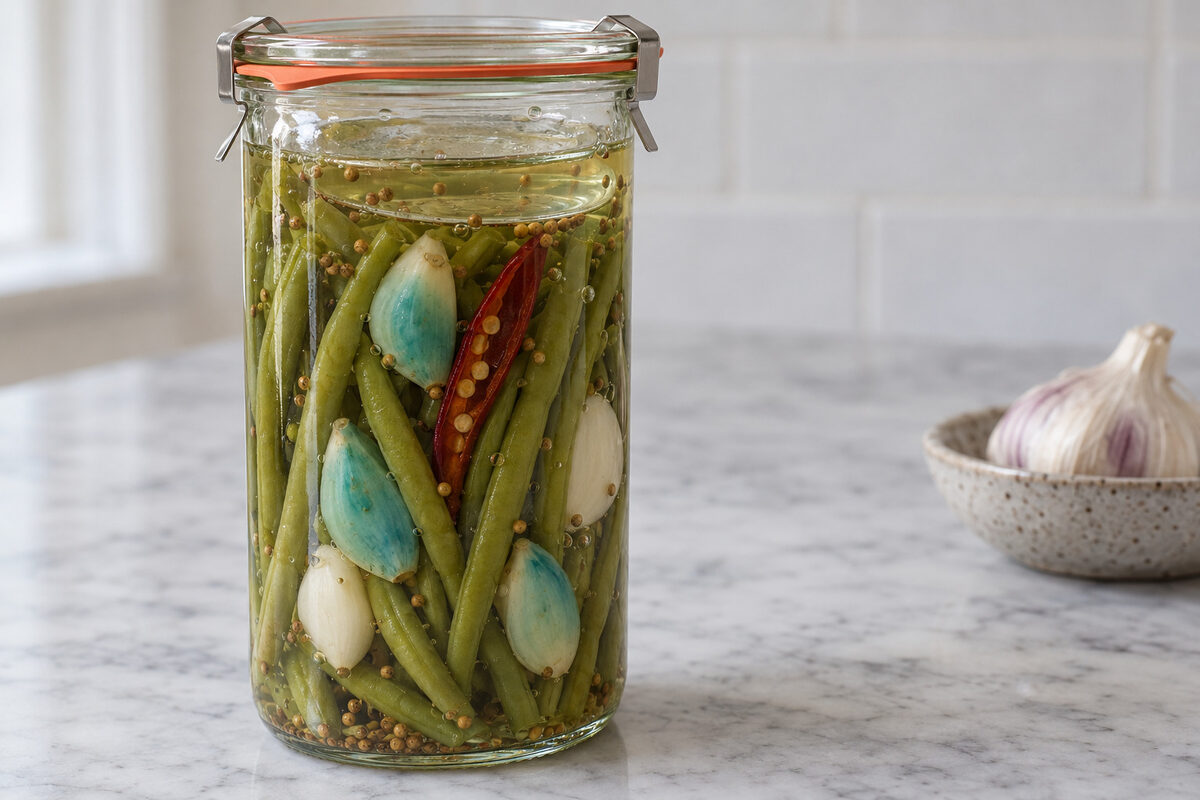
The garlic cloves in a ferment or a pickle have turned blue, bluish-green, purple or pinkish. Sometimes only a few cloves change, or only part of each one, while the rest stay white. Everything else in the jar looks the same.
Why it happens
Garlic contains pigments called anthocyanins, which dissolve in water and turn blue or purple in an acidic setting such as the brine of a ferment or vinegar. Some garlic has more bluish pigment than others, and it shows after pickling. It happens more with young garlic, and with old garlic too, and it can vary between cloves from the same head.
There's another cause: metals. Iron, tin or aluminum in the pot, the water or the pipes can react with the garlic's pigments. And copper in the water reacts with its sulfur compounds to form a blue compound.
What to do
It's normal: carry on
The color on its own changes nothing: extension guides don't ask you to throw out pickles over blue garlic. What matters is what always matters:
- The surface: fuzz or green, blue, brown or black spots in the jar are mold, and then everything goes. Mold needs air: a smooth blue clove inside the brine is usually just the pigment.
- The smell: if it smells rotten, throw it out.
- The texture: if it's slimy, throw it out.
- Metals: if you fermented with brass, copper or zinc utensils or containers, don't eat it.
This page is about garlic as part of a recipe, such as pickles or kimchi. Fermenting garlic on its own in brine is a different matter: there are no validated recipes for it. When in doubt, throw it out.
How to prevent it
- Mature, fresh garlic. If you grow your own, cure it for two to four weeks at about 70 °F (21 °C) before using it.
- Glass or food-grade plastic containers; no aluminum, copper, brass, galvanized metal or iron.
- Filtered or spring water.
Even so, it can still happen: it depends on each head of garlic, and sometimes on each clove.
Where every figure comes from
Every statement on this page comes from a food safety guide. We keep a copy of each source and quote its exact words, in its original language.
-
1
Garlic has pigments that turn blue or purple in acid
“Garlic contains anthocyanins, watersoluble pigments that can turn blue or purple in acidic environments like vinegar or pickling brine”
University of California Agriculture and Natural Resources (Harris, UC Davis) · Garlic: Safe Methods to Store, Preserve, and Enjoy (ANR Publication 8568, October 2016) · read on October 25, 2026
-
2
It happens more with young garlic, and can vary from clove to clove
“is more likely to occur with immature garlic, but it can differ among cloves from a single head of garlic.”
University of California Agriculture and Natural Resources (Harris, UC Davis) · Garlic: Safe Methods to Store, Preserve, and Enjoy (ANR Publication 8568, October 2016) · read on October 25, 2026
-
3
Some garlic has more bluish pigment, which shows after pickling
“Or, the garlic may naturally have more bluish pigment, and it is more evident after pickling.”
Clemson Cooperative Extension, Home & Garden Information Center · Common Pickle Problems (HGIC 3101, revised August 2020) · read on October 26, 2026
-
4
Iron, tin or aluminum in the pot or the water can color it too
“This reaction may be due to iron, tin, or aluminum in your cooking pot, water, or water pipes reacting with the garlic’s pigments.”
Clemson Cooperative Extension, Home & Garden Information Center · Common Pickle Problems (HGIC 3101, revised August 2020) · read on October 26, 2026
-
5
Cure young garlic for two to four weeks at about 70 °F
“Immature bulbs should be cured two to four weeks at 70 ° F.”
Clemson Cooperative Extension, Home & Garden Information Center · Common Pickle Problems (HGIC 3101, revised August 2020) · read on October 26, 2026
-
6
No aluminum, copper, brass, galvanized or iron containers
“Do not use aluminum, copper, brass, galvanized, or iron containers for fermenting pickles or sauerkraut.”
Clemson Cooperative Extension, Home & Garden Information Center · Common Pickle Problems (HGIC 3101, revised August 2020) · read on October 26, 2026
-
7
Young or old garlic can turn pink or blue; mature garlic is better
“Use fresh, mature garlic. Immature or old garlic sometimes turns pink or blue as anthocyanins (coloring pigment) react to acid.”
Oregon State University Extension Service · Pickle Fact Sheet (SP 50-466, revised April 2024) · read on October 26, 2026
-
8
With copper in the water, garlic may turn blue; the pickles can be used
“Garlic contains sulfur compounds, which may react with copper to form copper sulfate, a blue compound. Use the pickles.”
Oregon State University Extension Service (copy hosted by UC ANR) · Pickles and Relishes: Problems and Solutions (SP 50-744, revised January 2017) · read on October 26, 2026
Show the remaining 9 claims
-
9
If brass, copper or zinc utensils were used, don't eat it
“Dark or discolored pickles. (If brass, copper or zinc utensils and brining equipment were used, do not use pickles.)”
National Center for Home Food Preservation (USDA, University of Georgia) · Causes and Possible Solutions for Problems with Fermented Pickles · read on October 26, 2026
-
10
Mold is usually green, blue, brown or black
“Mold is typically green, blue, brown, or black in color.”
UC Davis, Department of Food Science and Technology · Common issues with fermented fruits and vegetables (v1.0, 15-mar-2022) · read on October 20, 2026
-
11
Mold needs air
“Molds require oxygen to grow.”
UC Davis, Department of Food Science and Technology · Common issues with fermented fruits and vegetables (v1.0, 15-mar-2022) · read on October 20, 2026
-
12
If there is mold anywhere, the whole batch goes
“If you confirm mold growth on any part of a ferment, it should be immediately discarded.”
UC Davis, Department of Food Science and Technology · Common issues with fermented fruits and vegetables (v1.0, 15-mar-2022) · read on October 20, 2026
-
13
A rotten smell means a failed ferment
“A putrid smell indicates a failed fermentation.”
UC Davis, Department of Food Science and Technology · Common issues with fermented fruits and vegetables (v1.0, 15-mar-2022) · read on October 20, 2026
-
14
If it's slimy or smells rotten, throw it out
“If fermented product is slimy, smells spoiled/rotten, discard it.”
University of Illinois Extension · Fermentation handout (2020) · read on October 20, 2026
-
15
When in doubt, throw it out
“When in Doubt—Throw it Out”
University of Illinois Extension · Fermentation handout (2020) · read on October 20, 2026
-
16
Filtered or spring water is best
“Filtered water or spring water are preferred.”
University of Illinois Extension · Fermentation handout (2020) · read on October 20, 2026
-
17
There are no validated recipes for fermenting garlic on its own
“There are currently no validated recipes for fermenting garlic.”
Ask Extension (Loretta Sweeney, Franklin County, Ohio) · Food preservation and safety: lacto-fermenting garlic #930666 (2026) · read on October 25, 2026