






Sauerkraut turned pink
The short answer It depends on what you see
It depends on the cabbage: with red cabbage or beets, the pink is their pigment and it's normal. If white cabbage turns pink, it may be yeast, and at home you can't tell: here it goes.
Reviewed October 27, 2026 · 18 facts, each with its source
 AI
When in doubt, throw it out. Fervida can’t see your jar. No page can tell you something is safe: it can show you how to look.
What you see
There are three very different cases:
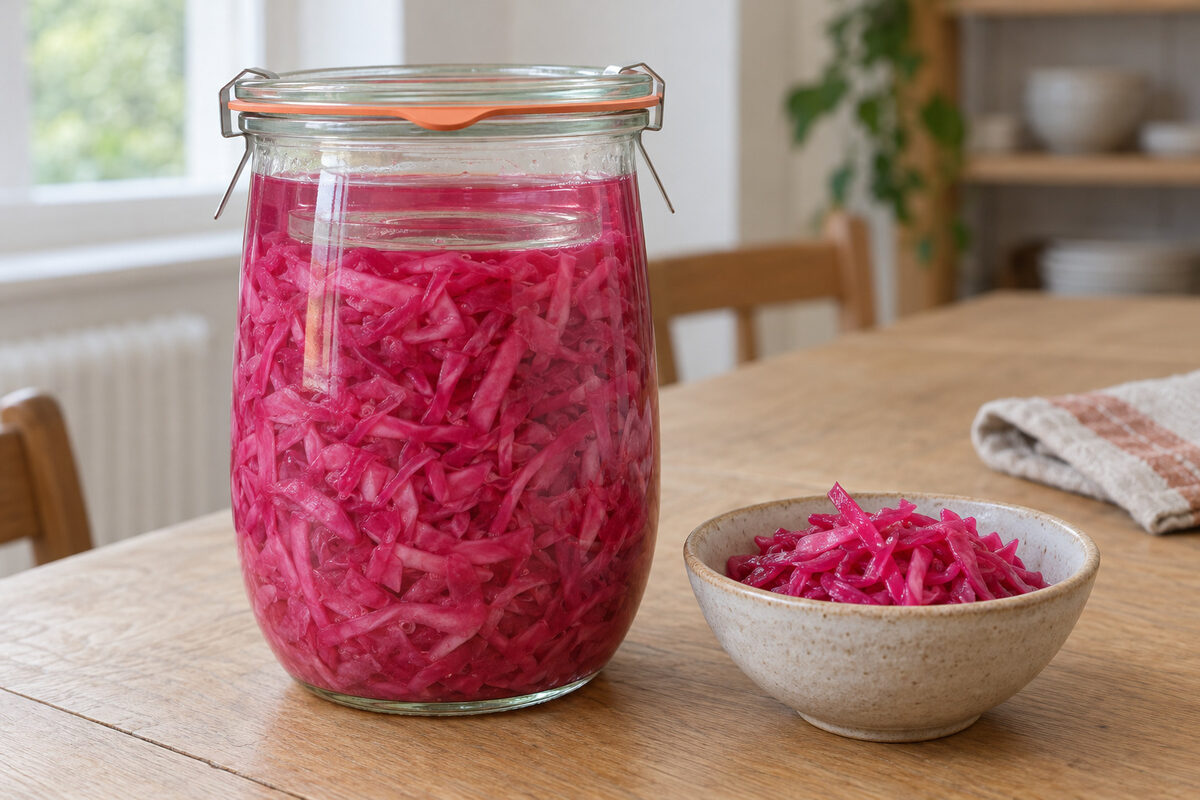
- Red cabbage sauerkraut. The cabbage and the liquid shift from purple to magenta or pink as it ferments. The change is even, throughout the jar.
- Sauerkraut with beets. The liquid and the cabbage are stained pink or red.
- White cabbage sauerkraut. The cabbage has turned pink, sometimes in patches or in the top layer. Other times the pink is only a flat film on the liquid.
Why it happens
In red cabbage, the color comes from the cabbage's natural pigments, which change with acidity: the more acidic, the pinker. That's why, if the top turns back to purple, the pH may have risen there. In the University of California, Davis photo, what raised it was a white mold growing on cabbage that had been left above the brine. Beets stain with their own pigments, which dissolve in water.
If it's white cabbage that turns pink, the guides give two possible causes: the cabbage's own pigments, or yeasts that have grown in it. They link the yeast to too much salt, salt spread unevenly, or cabbage that wasn't properly covered or weighted down, and it thrives on high salt.
What to do
It depends on the cabbage
- Red cabbage or beets, with the color evenly spread, a sour smell and no slime or mold: it's normal, carry on. With red cabbage, if the top turns back to purple, look at it closely: if it's fuzzy, even white, it's mold and the whole batch goes. If it's smooth, push the cabbage back under the brine and check the pH if you can: it must not rise above 4.6.
- A flat pink film on the liquid, with the cabbage below keeping its color: it's usually kahm. Skim it off with a clean spoon and check that the cabbage is still below the brine.
- White cabbage stained pink: it could be pigment or it could be yeast, and at home you can't tell which. The Washington State University guide says to discard sauerkraut turned pink by yeast, and Clemson's says to discard pickles that turn pink when yeast is visible. So here it goes.
If it's also slimy, smells rotten or has fuzz or colored spots, throw it out regardless. When in doubt, throw it out.
How to prevent it
- The salt the recipe calls for, weighed and mixed well into the cabbage.
- All the cabbage below the brine, with a weight on top.
- A temperature of 70–75 °F (21–24 °C).
Where every figure comes from
Every statement on this page comes from a food safety guide. We keep a copy of each source and quote its exact words, in its original language.
-
1
Acidity brings out the cabbage's natural pigments
“Natural pigments in cabbage enhanced by acidity.”
Oregon State University Extension Service · Sauerkraut: Problems and solutions · read on October 26, 2026
-
2
Pink comes from yeast, from too much salt, uneven salt or poor cover
“Yeast growth due to excess or uneven salt distribution or improper coverage.”
Oregon State University Extension Service · Sauerkraut: Problems and solutions · read on October 26, 2026
-
3
If the pink comes from the cabbage's pigment, nothing needs doing
“If caused by cabbage pigmentation, no action needed.”
Oregon State University Extension Service · Sauerkraut: Problems and solutions · read on October 26, 2026
-
4
The right salt, well mixed, and fermenting at 70–75 °F
“Use the correct amount of salt, mix well, and keep fermentation temperature between 70°F and 75°F.”
Oregon State University Extension Service · Sauerkraut: Problems and solutions · read on October 26, 2026
-
5
Beet pigments dissolve in water
“Betalains are natural, water-soluble pigment compounds”
Foods (MDPI; Jakubczyk et al.), via PubMed Central · Phenolic Compounds and Antioxidant Properties of Fermented Beetroot Juices Enriched with Different Additives (2024) · read on October 25, 2026
-
6
Yeast thrives on high salt
“Yeast thrives on high salt concentrations.”
Washington State University Extension, Lewis County · Sauerkraut Making · read on October 26, 2026
-
7
Sauerkraut turned pink by yeast is discarded
“Pink kraut • Yeast growth on surface caused by too much salt, uneven (Discard) distribution of salt or if kraut is improperly covered or weighted during fermentation.”
Washington State University Extension, Lewis County · Sauerkraut Making · read on October 26, 2026
-
8
White, gray or pink films can form
“White, grey, or pink films may form on the surface of fermenting fruits or vegetables.”
UC Davis, Department of Food Science and Technology · Common issues with fermented fruits and vegetables (v1.0, 15-mar-2022) · read on October 20, 2026
Show the remaining 10 claims
-
9
In red cabbage, white mold on cabbage left above the brine raises the pH and the color turns back to purple
“White mold growth on sauerkraut stored outside brine, causing it to change color to purple instead of red due to an increase in pH”
UC Davis, Department of Food Science and Technology · Common issues with fermented fruits and vegetables (v1.0, 15-mar-2022) · read on October 20, 2026
-
10
The pH must not rise above 4.6
“The pH can be checked periodically to ensure it does not rise above 4.6.”
UC Davis, Department of Food Science and Technology · Common issues with fermented fruits and vegetables (v1.0, 15-mar-2022) · read on October 20, 2026
-
11
On sauerkraut, yeast is skimmed off from time to time
“For other ferments, such as sauerkraut, yeast should be periodically removed during fermentation.”
UC Davis, Department of Food Science and Technology · Common issues with fermented fruits and vegetables (v1.0, 15-mar-2022) · read on October 20, 2026
-
12
Mold is usually green, blue, brown or black
“Mold is typically green, blue, brown, or black in color.”
UC Davis, Department of Food Science and Technology · Common issues with fermented fruits and vegetables (v1.0, 15-mar-2022) · read on October 20, 2026
-
13
If there is mold anywhere, the whole batch goes
“If you confirm mold growth on any part of a ferment, it should be immediately discarded.”
UC Davis, Department of Food Science and Technology · Common issues with fermented fruits and vegetables (v1.0, 15-mar-2022) · read on October 20, 2026
-
14
Every vegetable below the brine
“All produce should be submerged in the brine liquid.”
UC Davis, Department of Food Science and Technology · Common issues with fermented fruits and vegetables (v1.0, 15-mar-2022) · read on October 20, 2026
-
15
If pickles turn pink and yeast is visible, throw them out
“However, yeast growth could also cause this. If yeast growth is evident, discard the pickles.”
Clemson Cooperative Extension, Home & Garden Information Center · Common Pickle Problems (HGIC 3101, revised August 2020) · read on October 26, 2026
-
16
If it's slimy or smells rotten, throw it out
“If fermented product is slimy, smells spoiled/rotten, discard it.”
University of Illinois Extension · Fermentation handout (2020) · read on October 20, 2026
-
17
When in doubt, throw it out
“When in Doubt—Throw it Out”
University of Illinois Extension · Fermentation handout (2020) · read on October 20, 2026
-
18
A weight on top keeps the vegetables under
“Placing a weight (such as a jar or brine-filled bag) on top to keep them submerged is a good idea.”
K-State Research and Extension (Kansas State University) · Taking a New Look at Fermented Foods (MF3491, June 2020) · read on October 20, 2026